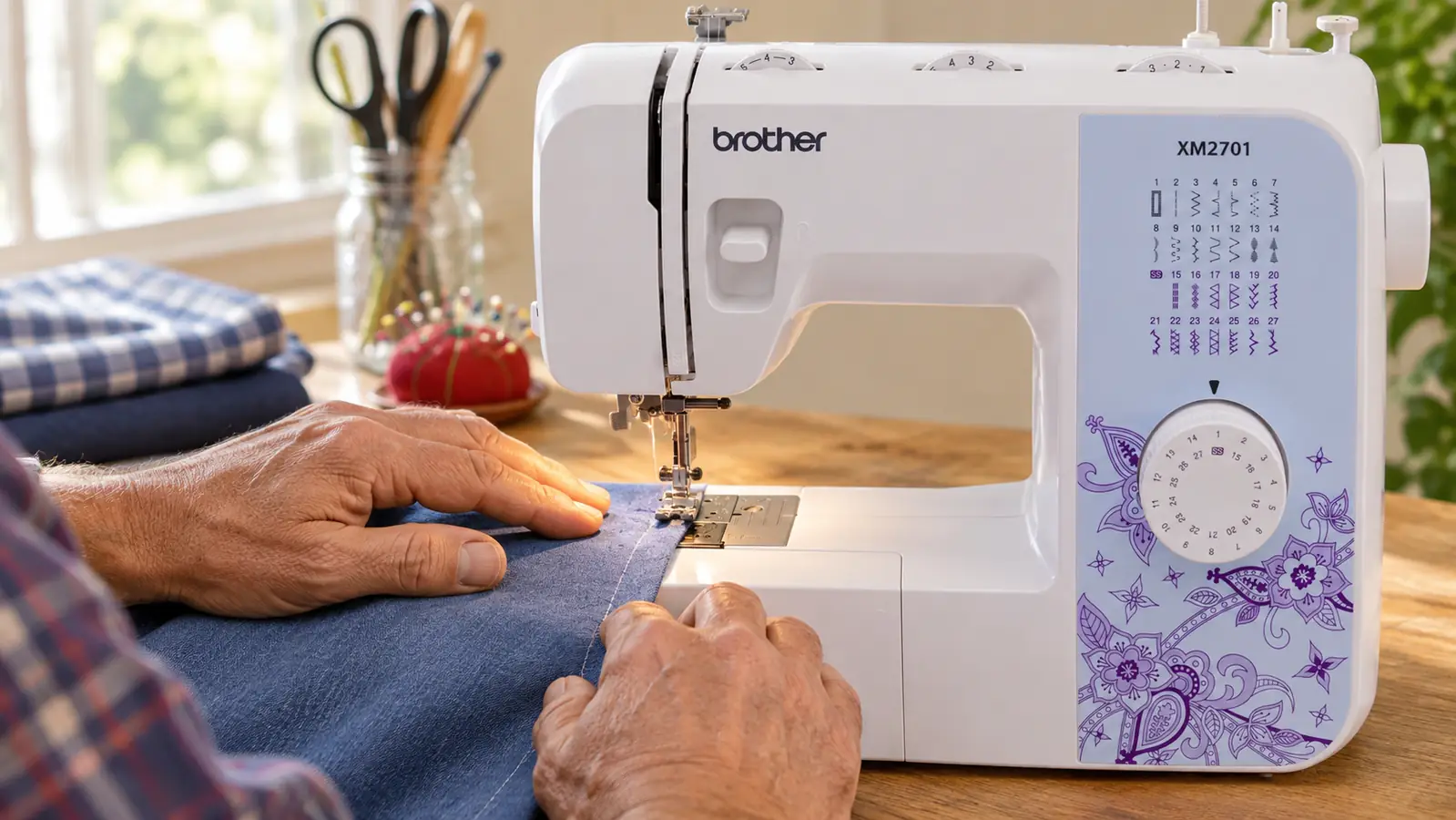
Choosing a first sewing machine should be simple. Then you read forty reviews at midnight and it is not. So here is the short answer, and I will spend the rest of this page explaining it. If you sew clothes for yourself and for the women in your family, the Brother XM2701 is the machine I would put in front of you. I am not telling you it will out-sew everything else on the shelf. I am telling you that the things that make a home dressmaker quit are threading, bobbin changes and stitches that will not behave, and the Brother handles those three better than the Singer 4423 does.
I have sewn on both. Mine lives on the long table in my sewing room, and a neighbour's Singer 4423 spent an afternoon under my hands while I helped her take in a stack of school trousers. The Singer is the stronger machine. That is not marketing talk, it is what you feel when four layers of denim go under the needle. But stronger is not the same as better for the way you sew, and the woman who buys the heavier machine because someone told her heavier was better often ends up with it under a cover by March. So let me lay both of them out the way I would at the cutting table.
| Brother XM2701 | Singer 4423 | |
|---|---|---|
| Built-in stitches | 27, including decorative stitches and a blind hem | 23, with fewer decorative options |
| Needle threading | Automatic needle threader built in | You thread the eye by hand |
| Bobbin | Drop-in top bobbin, right where you can see it | Front-loading bobbin in a removable case |
| Extras in the box | 6 sewing feet, twin needle, 3-piece needle set, 4 bobbins, darning plate | A smaller starter set |
| Thick seams and heavy fabric | 12.6 pounds, it slows and can stitch short over a folded denim seam | Heavier frame that keeps its rhythm through denim and canvas |
| Speed on long seams | Slower and calmer, easy to steer | Faster, and you feel it in your shoulders by evening |
| Warranty | The listing states no warranty | A limited warranty on the frame that runs for years, not months |
| Moving it around | 12.6 pounds and 15.3 by 5.86 by 12.01 inches, easy to carry to a class or the kitchen table | Heavier, it stays where you put it |
| Best for | Dressmaking, alterations, teaching yourself to sew | Denim, canvas, bag making, long production runs |
Where the Brother XM2701 Wins
Start with the needle. The XM2701 has an automatic needle threader built into the machine, and at sixty-one, with my reading glasses pushed up on my head, I no longer treat that as a luxury. I treat it as the difference between finishing a project and going to bed. Threading by hand is the small job that ends an evening. You finish a seam at nine o'clock, you want to start the next one, and instead you spend four minutes squinting at an eye you cannot quite see. The Singer asks you to do that every single time. The Brother does not.
I keep a spool of pale grey thread for testing, and on the Singer afternoon I threaded it four times in an hour. Once at the start, once after the bobbin ran out, once when the thread jumped the tension disc, and once more because my neighbour had rethreaded it her own way and wanted me to check it before she carried on. Four threadings does not sound like much. It is the difference between finishing the second side seam and leaving it for tomorrow, and tomorrow is where half-finished garments go to live for a year.
The second thing is the bobbin. The Brother takes a drop-in top bobbin, so you lift the cover, drop the bobbin in, follow the marked path with the thread and you are sewing again in under a minute. Front-loading bobbins, which is what the Singer uses, are not difficult once you have done it a hundred times. The first twenty times are a small humiliation, and I have watched capable women abandon a whole afternoon over a bobbin case that would not seat. If you are learning alone, with no one at the next table to check your work, that matters more than stitch count.
Then the stitch menu. Twenty-seven built-in stitches, including decorative stitches and a blind hem. In dressmaking the blind hem earns its keep far more than the pretty ones. It is the stitch that lets you finish a wool skirt or a pair of wide-leg trousers so the hem disappears into the fabric instead of announcing itself from across the room. The Singer carries twenty-three stitches, which is plenty for construction, but it gives you less to work with when you want the inside of a garment to look as considered as the outside.
And there is the plain matter of where it lives. The Brother weighs 12.6 pounds and measures 15.3 by 5.86 by 12.01 inches, so I can lift it to the kitchen table when my granddaughter wants to sew beside me, and put it back on the shelf when we are done. Six sewing feet come in the box, along with a twin needle, a three-piece needle set and four bobbins, so you are not ordering extras in week one to do the job you bought the machine for.
Where the Singer 4423 Wins
Now the part where the Singer walks away with it. Put four layers of denim under the Brother's needle and you will hear the machine slow down. It is a light machine and a light machine has less behind the needle. The Singer has a heavier frame, and it pushes through thick seams with an even rhythm the Brother cannot match. If you make jeans, if you sew canvas bags, if you are the person in the family who shortens work trousers and mends backpacks, that difference is real and it is not a small one. I have unpicked seams of my own because the machine stalled halfway along a fold and the stitches went short and tight.
The trousers were a stack of eleven pairs, all school uniform grey, each needing two inches off the leg and a fresh hem. On the Singer I did them in one sitting and drove them back the same evening. On my Brother I would have split them across two evenings, turned the hand wheel through each side seam and pressed as I went. Eleven pairs is not a normal week for me. It is exactly the job that decides which machine belongs in a house, and pretending otherwise would be doing you a disservice.
The Singer also runs faster. On a long straight seam, a curtain hem, a gathered skirt, speed is a genuine pleasure, and the Singer gives you more of it. It is louder too, and it asks more of your hands. A fast machine with a heavy frame will not forgive a wandering eye. If you are teaching yourself to sew, that combination is a little like learning to drive in a truck. Perfectly possible. Just less kind to you in the first month.
The last point is the boring one, and I would rather you heard it from me than found it in small print at the bottom of a listing. The Singer carries a limited warranty on the frame that runs for years rather than months. The Brother's listing states no warranty at all. That does not make it a bad machine, it makes it a machine you buy carefully. Buy it somewhere with a return window you trust, keep the receipt, and if something is wrong, deal with it in the first fortnight rather than the second year.
The machine I hand to every woman who asks me at the fabric shop
Twenty-seven stitches, an automatic needle threader, a drop-in bobbin and six feet in the box. If you sew clothes and you are tired of fighting your machine, this is where I would start.
Amazon Check Today's Price on Amazon →Threading a needle by hand is the small job that ends an evening. On the Brother you pull the lever, the hook finds the eye, and you are sewing again.
What the First Month Actually Feels Like
The first week is set-up and caution. You read the manual with the machine in front of you, you wind a bobbin, you sew lines on a scrap of muslin until the seam is straight. This is the stage where people decide the machine is faulty because the thread keeps snapping, when in truth the machine is fine and the threading path is not. The first project I made on the Brother was a simple gathered skirt for my granddaughter, cotton, nothing clever, and the whole thing took an afternoon because I kept stopping to check myself.
The second and third week are where the machine starts to feel like yours. You stop looking at the manual for the bobbin, you learn how much pressure your foot puts on the pedal, and you find the pace where the fabric feeds evenly instead of being dragged. Somewhere in there you will meet a seam the Brother does not care for, probably a thick waistband where the fabric doubles back on itself, and you will learn to turn the hand wheel through the lump rather than forcing it with the pedal. Every machine has that seam. On a lighter machine you meet it sooner.
Mine was a cotton skirt with a doubled band, four layers at the side seam where the band joins the body. The Brother managed three of the four and then went short, the stitches pulling tight and small like a row of pinpricks. I lifted the presser foot, turned the hand wheel by hand through the lump and carried on. It is a two-second habit and it has saved me on every heavy seam since, including a boiled wool jacket I would not have trusted to a machine I did not know.
By the fourth week the difference between the two machines is no longer about specifications. It is about whether you sat down. A machine that threads quickly and takes a bobbin without a fight gets used on a Tuesday evening for a twenty-minute alteration. A machine that makes you sigh before you begin gets used on weekends only, and then rarely. Almost every woman I know who stopped sewing did not stop because she lost interest. She stopped because the setup was tedious and the finishing looked homemade.
What Comes in the Box, and Why It Matters
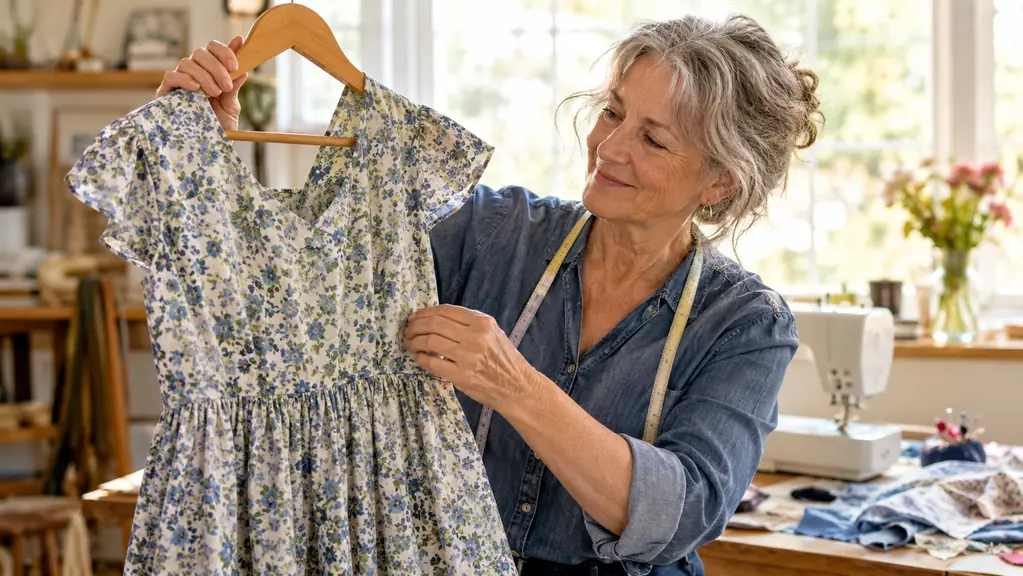
The Brother arrives with six sewing feet, a twin needle, a three-piece needle set, four bobbins, a darning plate, a screwdriver and the manual. That sounds like a list of small things until you are mid-project on a Sunday and need one of them. The feet cover jobs you have not met yet, and the twin needle is what lets you finish a knit hem with two parallel rows and a little stretch between them, which is the difference between a t-shirt hem that survives the wash and one that pops. The darning plate is for the mending pile that every household has.
The blind hem stitch has earned its keep more than any other in the menu. On a wool skirt it turns the hem under and stitches it so the line all but disappears from the outside, which is the whole point of a hem on a good piece of cloth. I have used it on three skirts and one pair of trousers this year, and not once has anyone asked me who made them, which is the compliment I am actually after.
The Singer arrives with a leaner set, which is part of why it feels like a machine aimed at someone who already owns a drawer of supplies. Neither approach is wrong. But if this is your first machine and you are equipping a corner of a spare bedroom from nothing, the Brother gets you further before you have to go shopping again. That is not a reason on its own to choose it. It is a reason to stop worrying that you are buying the lesser option.
Who Should Buy Which
Buy the Brother XM2701 if you sew clothes. If your projects are dresses, skirts, blouses, pyjamas, school uniforms and the endless alterations that come with three generations of women in one family, this is the machine that will not stand between you and the work. It threads itself, it holds its bobbin where you can see it, and it has a blind hem for the hems that people actually notice. It is also the better machine to learn on, because it is slower and it forgives you while you build the habit.
My granddaughter is fifteen and still growing, which means a dress I cut in March needs the shoulders taken up by June. On a machine that threads itself that is a twenty-minute job between dinner and homework. On a machine that does not, it is an evening, and an evening is a week, and the dress sits on the back of a chair until it no longer fits at all. That is the whole argument in one garment, and I have watched it happen in my own house more than once.
Buy the Singer 4423 if you sew things that fight back. If your cutting table is covered in denim, canvas, upholstery weight or bag making, if you are the neighbour everyone brings their work trousers to, the extra weight and push are worth the trade in convenience. It is a good machine. It is simply not a dressmaker's first machine, and I would rather tell you that plainly than let you buy it because the number on the box was higher. The right machine is the one that matches the work on your table, not the one that wins an argument online.
If you are sewing clothes rather than tarps, start here
The Brother XM2701 threads itself, keeps its bobbin in plain sight and gives you a blind hem for the hems that matter. It is the machine I would put under a beginner and keep using myself.
Amazon Check Today's Price on Amazon →