I bought the Brother XM2701 for my granddaughter's sixteenth birthday and then sewed on it myself for three weeks before I let her have it. That is my habit with any machine that comes into this house. I want to find the awkward parts on my own time, not watch a beginner I love sit down at a machine and quietly decide that she is the problem. She is not the problem. No beginner ever is. A machine has a personality and you learn it, the same way you learn a car that pulls a little to the left.
So here is the honest version, the one I would give you at the cutting table with a cup of tea going cold at your elbow. The Brother XM2701 is a genuinely useful first machine and I would hand it to almost any beginner without hesitating. It also has a ceiling, and you should know where that ceiling is before you buy, because the reviews calling it perfect tend to be written by people who have not yet tried to set a sleeve into a heavy wool coat on it.
The Quick Verdict
A forgiving, well-equipped starter machine that does most of what a home dressmaker needs. It also tells you, in the middle of a thick seam, exactly where its limits sit.
Amazon Check Today's Price →The machine I hand to beginners, at today's price
27 built-in stitches, an automatic needle threader, a drop-in top bobbin and six presser feet in the box. Check the current listing before you decide.
Amazon Check Today's Price on Amazon →How I Actually Used It
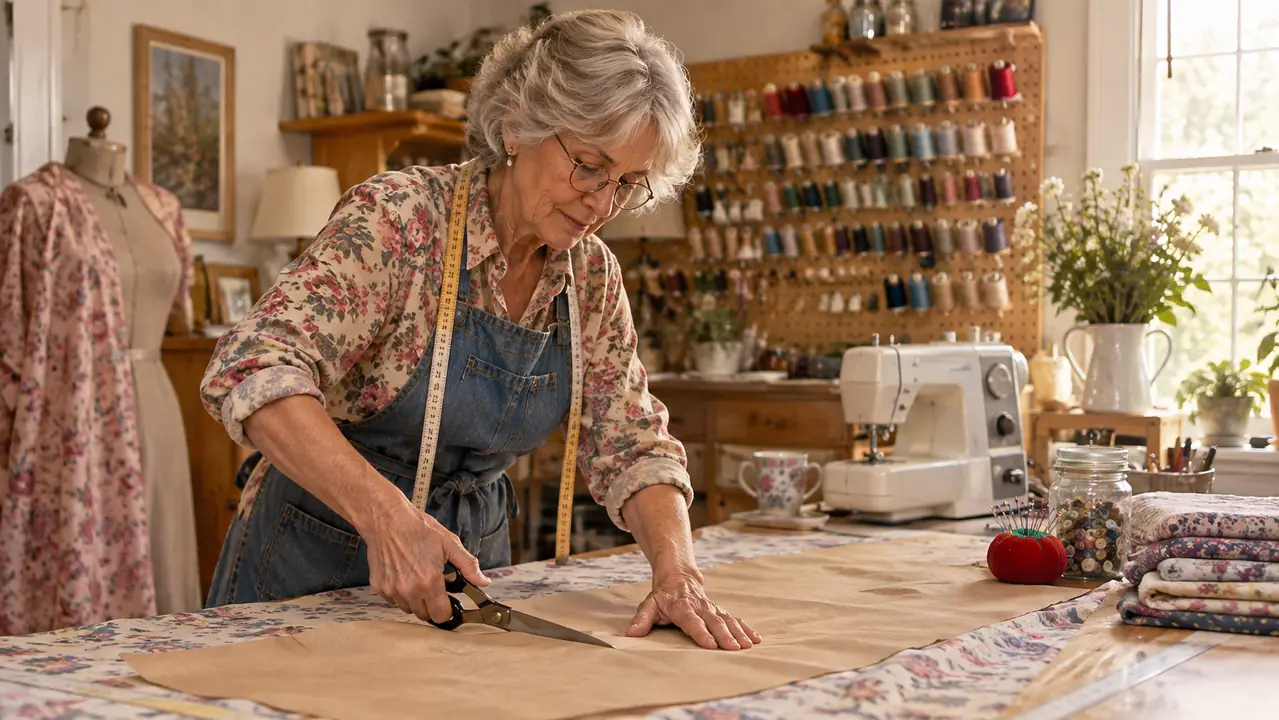
Three weeks, one machine, and a list of jobs I would have done anyway. I hemmed two pairs of my daughter's trousers, took in the side seams of a linen top that had been hanging in my closet unworn for a year, ran up a calico test bodice to check a pattern before I cut good fabric, and made my granddaughter a simple cotton skirt with a straight waistband. Nothing exotic. All of it is the work a beginner actually does.
The trouser hem was the first job, on a Tuesday, and it taught me the machine's temperament. My daughter is five foot ten and buys her trousers long, so I took up two inches on each leg and finished them with the blind hem. My first pass caught the fabric through to the right side, and I want to be clear that this was my folding of the hem allowance and not anything the machine did wrong. I unpicked it, refolded, pressed it flat, and the second pass came out invisible from the right side. That is the whole lesson of this machine: it does exactly what you set it up to do, so when a seam goes wrong, look at your setup before you blame the tool.
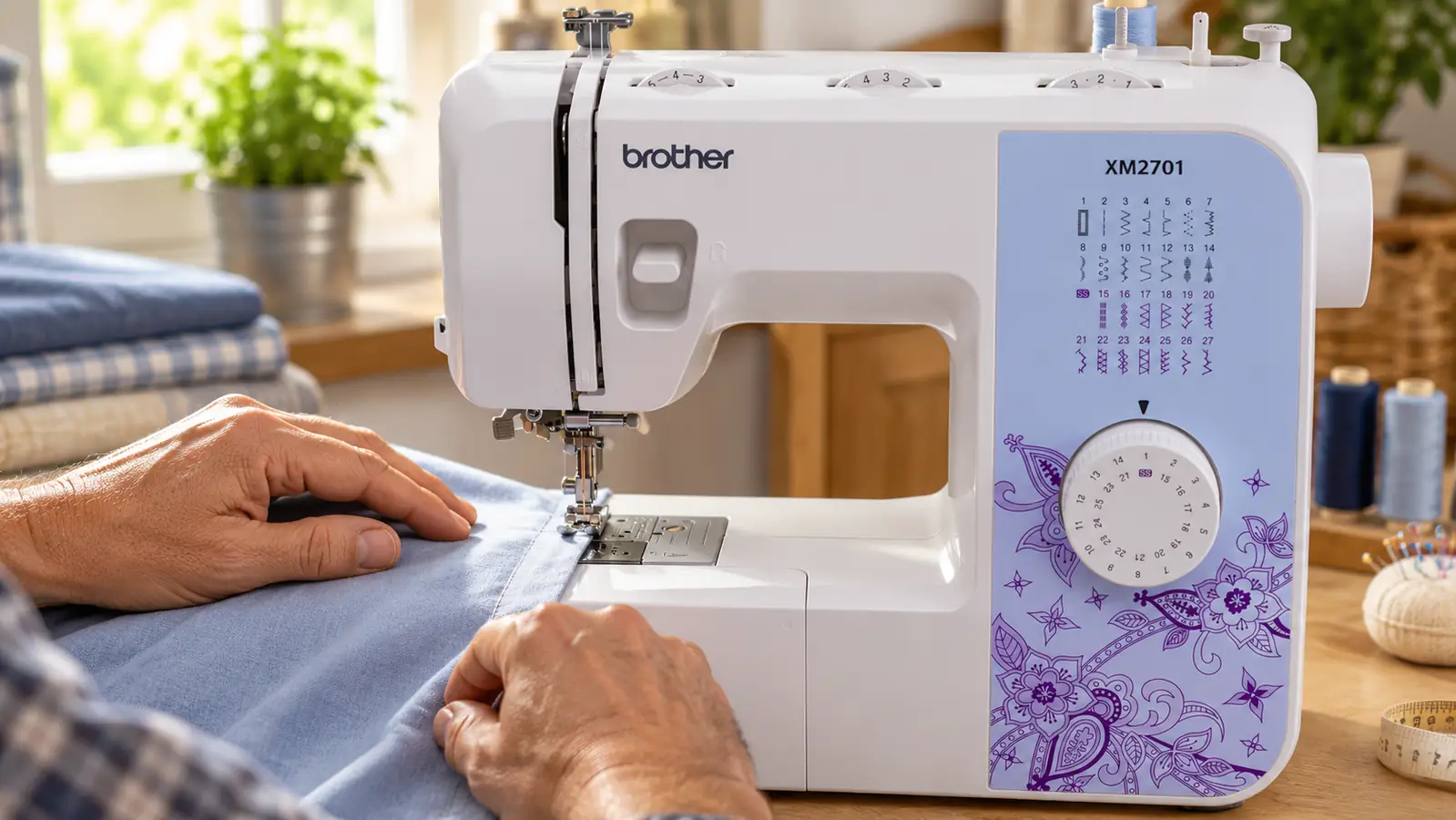
The two features that did the most for me are the ones that have nothing to do with how a stitch looks. The automatic needle threader works, and it works on the first try more often than not, which matters more than any decorative stitch on the menu. The drop-in top bobbin means you set the bobbin into the top of the machine instead of fishing underneath, and you can see the thread path with your own eyes. If you have ever lost ten minutes to a bobbin that wound wrong, you know why I am leading with this.
The machine came with six presser feet, and I used two of them for nearly everything. That is worth saying plainly, because a box full of feet can make a beginner feel like she is behind before she has started. You are not behind. Learn one foot, learn what a seam allowance looks like, and let the rest sit in the bag until a pattern asks for them.
The calico bodice was the job that convinced me. It was a pattern I had made once before for my daughter and wanted to try on my granddaughter, whose shoulders are narrower and whose bust is fuller, so the fitting problems were not the same at all. I ran it up in unbleached calico without finishing a single seam, purely to see the fit on her, and the straight stitch ran true through a good eight yards of that cheap cotton without one skipped stitch or one snarl underneath. I found a full inch of excess through the upper chest before I ever cut the good linen, and I found it in an afternoon rather than after a finished garment and a wasted length of fabric I could not replace. That afternoon is the whole argument for this machine.
What It Does Well
The Brother XM2701 carries 27 built-in stitches, including decorative stitches and a blind hem. Here is my honest accounting of that number. I used a straight stitch, a zigzag for finishing raw edges, and the blind hem. On knits I reached for a stretch stitch. That is four. The other twenty-three are not wasted, they are simply not the reason to buy the machine, and no beginner should feel she must work her way through them like a course syllabus. The blind hem alone earns its place, because a hem you cannot see from the right side is the difference between homemade and handmade.
I did try a few of the others out of curiosity, on a doubled scrap of cotton, because I think you should know what you are paying for. They stitched cleanly, with no skipped stitches and no nest of thread underneath, which is more than I can say for the cheap machine I learned on forty-odd years ago. What I could not see was a beginner needing them in her first year. They are pleasant to look at on a scrap. They are also the sort of thing you try once and then forget, and I would rather you spent that hour learning to sew a straight seam at an even seam allowance, because that is the skill every garment in your closet depends on.
The needle threader is the feature I would keep if I could keep only one. My eyes are sixty-one years old and they are not getting sharper. Threading a needle by hand on a machine that sits low on a table is the small daily friction that quietly ends a sewing habit. This machine removes it. My granddaughter threaded it on her own the first evening without asking me for help, and I watched her shoulders come down about an inch.
The drop-in bobbin and the four bobbins in the box deserve a mention for the same reason. Bobbins run out. They run out at the worst moment, in the middle of a long seam, usually on the last quarter inch. Being able to lift the plate, drop in a wound bobbin, and see that the thread is seated correctly saves you the guesswork that makes beginners doubt themselves.
Portability is real here. The machine weighs 12.6 pounds and runs on corded electric power at 120 volts, so it does not need a dedicated table or a permanent corner. Mine sat at the end of the long cutting table in the spare bedroom and I moved it aside when I needed the whole surface for pattern work. If your sewing space doubles as something else, as most of ours do, that matters.
The box also includes more than the machine. There is a darning plate, an accessory bag with a needle pack, a twin needle, a screwdriver, four bobbins, and a manual. The manual is not an afterthought. It is the second half of the product, and I will come back to that.
The needle threader is the feature that decides whether a beginner keeps sewing. Everything else on the machine is a preference.
Where It Stops Short
Four layers of mid-weight denim at a cross seam is where this machine asks for help. It slows, the needle labors, and you will find yourself turning the handwheel to walk it through the last half inch. That is normal for a machine in this class and it is not a defect. It does mean that if your plan is jeans, heavy coats, or canvas bags with many layers, you are asking a beginner machine to do a job it was not built for, and you will be unhappy in a way that has nothing to do with your skill.
When I say four layers, I mean the cross seam at the bottom of a trouser leg where the inseam meets the outseam, which is the thickest point on any pair. I tried it on a pair of my own heavy cotton twill work trousers, not true denim but close enough, and the machine took the flat sections happily and then stalled at that cross. I turned the handwheel by hand through the last half inch, the needle went through, and the stitch that came out was perfectly good. It simply was not something the machine wanted to do at speed, and I could feel it decide. On a machine built for that work, the same seam goes through without a thought. On this one, you plan for it.
The listing I read states no warranty on this machine. Read that line twice if you are the type who assumes every purchase comes with one. It does not change how the machine sews, and there are thousands of these in use, but it does mean you should keep the manual, keep your receipt in the drawer, and treat the machine with a little care rather than assuming someone will replace it if the stitching goes strange in year three.
The 27 stitches will not make a garment fit. I say this to every woman who asks me whether a machine with more stitches would make her clothes look better. It will not. Fit comes from the pattern, the measurements, and the willingness to baste and try on and rip. A machine only decides whether the seams are straight and the finish is clean. Once you accept that, the stitch count stops mattering and you can choose a machine on how it feels to use.
It is also a machine for light to mid-weight fabric at heart. Cotton, linen, calico, rayon, a light wool crepe: all of it behaves. Coat wool, upholstery canvas, and leather are not what this was designed for, and no amount of adjusting your technique will turn it into a machine that handles them. If those are your materials, save your money and buy for them from the start.
What I Liked
- The automatic needle threader works reliably, which removes the daily friction that ends sewing habits
- Drop-in top bobbin with four bobbins included, so you can see the thread path and reload in seconds
- 27 built-in stitches including a blind hem that produces a genuinely invisible finish
- Six presser feet, darning plate, twin needle and needle pack all in the box
- 12.6 pounds and corded electric, so it sits on a cutting table without needing a permanent setup
- Forgiving on cotton, linen and other light to mid-weight fabrics, which is what beginners actually sew
Where It Falls Short
- Slows and needs handwheel help on thick cross seams like four layers of denim
- The listing states no warranty, so factor that into what you expect
- Twenty-seven stitches is more menu than most sewers will ever use
- Not built for coat wool, canvas or leather, and no technique will change that
- The included manual does real work. Skip it and the machine feels harder than it is
What the Five-Star Reviews Leave Out
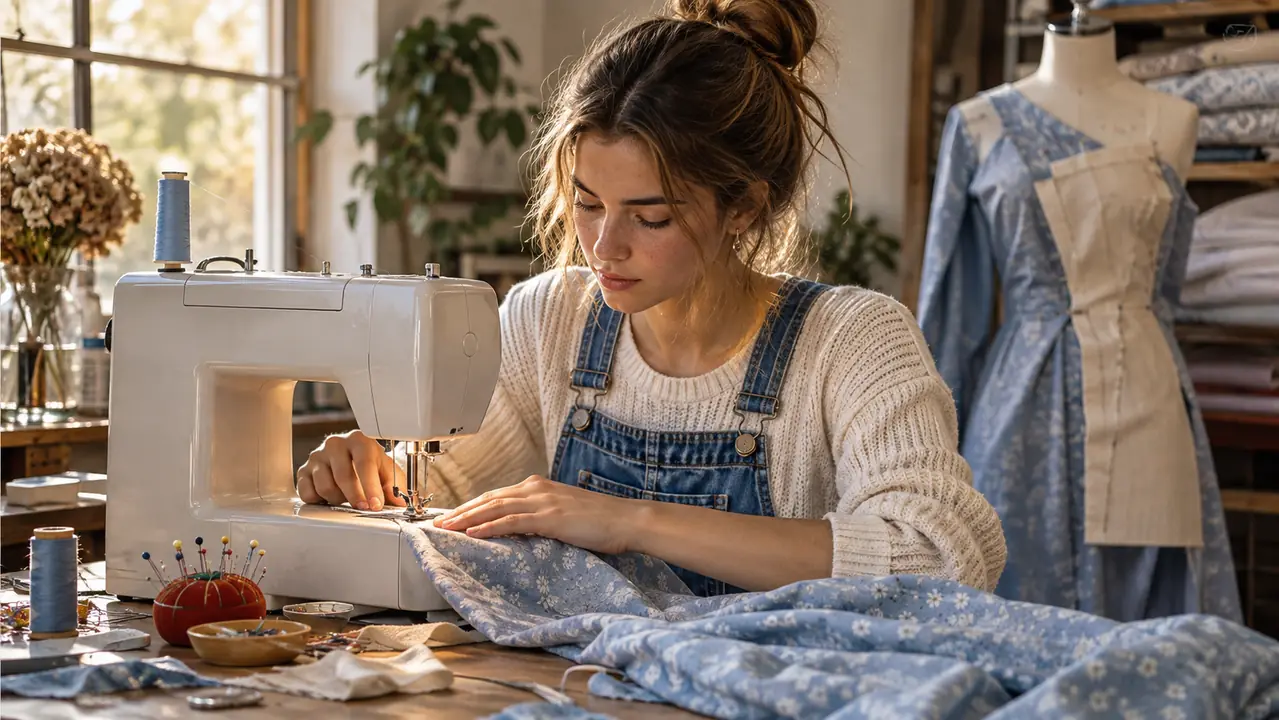
Nobody mentions that the manual is doing half the job. Stitch length, which foot goes with which stitch, how to wind a bobbin correctly: it is all in there, in plain language, with pictures. I have watched beginners declare a machine terrible when the presser foot was not down or the bobbin was threaded backwards. The Brother XM2701 is not exempt from that. Read the manual with the machine in front of you, needle in, and it will feel like a different product.
There is a section in that manual showing what a good stitch should look like next to one that is not, and it is worth ten minutes with a scrap of fabric and the reading glasses you keep meaning to replace. I sewed a line, looked at it, then compared it to the picture in the book. When the machine later pulled a loop underneath on a piece of slippery rayon, I did not panic and I did not drive forty minutes to a repair shop. I went back to that page, found that I had threaded the top wrong, rethreaded it, and the next seam came out clean. That is not a skill anyone is born with. It came out of a page most people throw away with the packaging.
Nobody mentions that you will probably want one or two extra feet within the first few months. A walking foot for quilting and heavier seams, a zipper foot if your patterns call for invisible zips. These are aftermarket additions and they cost money, so budget for them rather than being surprised. The six feet in the box cover ordinary garment construction, and they cover it well. They do not cover everything you will eventually want to do.
And nobody mentions that 12.6 pounds means the machine lives where you put it. It is portable in the sense that you can carry it to a class or set it on a different table. It is not so light that you will cheerfully lift it into a closet every Sunday night. If your only sewing surface is the kitchen table, plan on leaving it out for a few days at a time, and make peace with that before you buy.
Who This Is For
This is the machine for the woman who wants to make her first few garments and find out whether she loves sewing before she spends real money on it. It is also the machine for the woman who already sews but wants something simple to leave set up for alterations, hemming, and quick mending while the good machine stays threaded with a project. My granddaughter is the first case. I am the second, honestly, and I was a little sorry to hand it over.
It suits anyone sewing for a household with different bodies in it, which is my whole situation. Myself, my grown daughter, my teenage granddaughter, three shapes and three sets of fitting problems. A forgiving machine with a good blind hem and a reliable straight stitch handles the alterations that come with that far better than a complicated machine you are afraid to touch. If you are hemming trousers for a daughter who is taller than you and letting down a skirt for a granddaughter who is not, this is plenty of machine.
Who Should Skip It
If you already know you want to sew coats, jeans, bags or anything with several heavy layers, skip this one and buy for the work. You will spend more and you will be happier. The same goes for anyone who has sewn for years and is looking for a machine to grow into. The Brother XM2701 will not grow with you past a certain point, and pretending otherwise wastes your money.
And if you want a machine that will do the fitting for you, no machine will. Buy a tape measure and a dress form instead, and spend a season learning to baste. That advice is worth more than any stitch count, and it is the advice I give most often, usually to someone who did not ask for it. My apologies in advance.
If a simple, forgiving machine is what you actually need, this is the one
27 stitches, an automatic needle threader, a drop-in bobbin, six feet in the box, 12.6 pounds. Check the current listing and read the manual when it arrives.
Amazon Check Today's Price on Amazon →