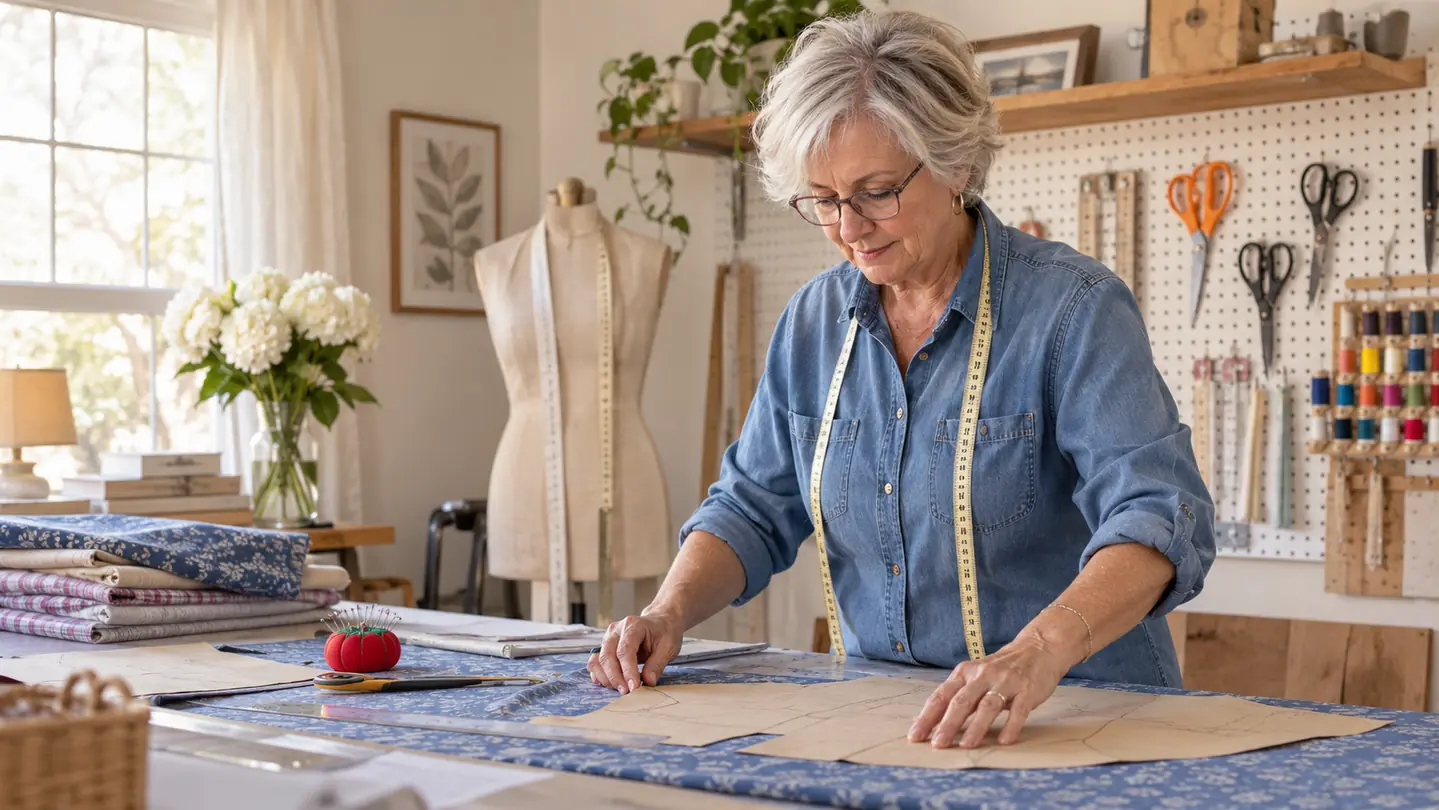
The first time I ran the Honey's Heaven Rotary Cutter Set along a curved bodice seam, I stopped and looked at the fabric twice. After thirty years of pinning, shearing and trimming, a clean curve in one pass still feels like a small piece of arithmetic that finally adds up. The set came with the 45mm cutter, five replacement blades, an A3 cutting mat, an acrylic ruler and craft clips. I put it on my long cutting table in the spare bedroom and used it on cotton shirting, linen, ponte knit and a lightweight wool blend for my daughter, my granddaughter and myself. That is three generations and three very different shapes, which is a fair test for any cutting tool.
If you sew clothes rather than quilts, the appeal is not the craft-clip novelty. It is the question of whether a rotary cutter can handle pattern pieces with curves, darts and seam allowances without dragging the fabric or chewing the corners. The Honey's Heaven set answers that question well for small and medium pieces. It answers it less well for a full skirt panel. I will explain both sides, because a cutting kit that is right for a collar stand is not automatically right for a circle skirt.
The Quick Verdict
A stable, complete cutter set that makes curves and small pattern pieces faster. The 18 by 12 inch mat is the real limit for dressmaking.
Amazon Check Today's Price →The cleanest curve I have cut in years came from a 45mm blade
The Honey's Heaven Rotary Cutter Set includes the cutter, five replacement blades, an A3 self-healing mat, an acrylic ruler and craft clips. It is a sensible first rotary setup for a home dressmaker who cuts often and wants the mat to stay put.
Amazon View the Honey's Heaven Set on Amazon →How I've Used It
I cleared the long cutting table, rolled out the A3 mat and kept the acrylic ruler within reach. The mat has a printed grid of 16 by 10 inches inside an 18 by 12 inch surface, and that grid became my reference for seam allowances and bias strips. I used the craft clips to hold folded fabric and pattern pieces when I was cutting facings and cuffs. The whole kit weighs 1.02 kg, so it sits on the table without sliding around when I press down on the cutter.
My first project was a linen button-down for my daughter. Linen shifts if you look at it wrong, but the cutter with a fresh SKS-7 steel blade went through two layers without pulling the weave. The adjustable screw system on the handle kept the blade steady. I did not have to tighten it mid-cut, though I checked it once after the first hour because any rotary cutter can work loose with use. The stainless steel handle felt secure in my hand, and the 45mm blade was small enough to follow the curve of the collar stand without clipping the seam allowance.
The second project was a ponte knit dress for my granddaughter. Knit can roll at the edges, so I spread it flat on the self-healing mat and used the grid to keep the grainline honest. The 45mm blade handled the neckline curves better than shears would have, and the cutter did not snag. The third project was a lightweight wool skirt for myself, and there the A3 mat showed its size. I had to cut the front panel in two passes, which is not a defect in the cutter but a fact of the mat. I checked the grainline twice and used the acrylic ruler to true the seam allowance after each pass.
I have changed one blade in several months of regular use. I cut mostly mid-weight fabrics, with some heavier linen and one denim waistband that dulled the edge faster. The five replacement blades mean I am not stopped when a blade starts skipping. The mat has stayed flat on the table, and the self-healing surface has closed after every cut. I have not treated it gently, but I have kept it flat and dry, which is what a 3 mm mat needs.
What Comes in the Box and How It Feels in the Hand
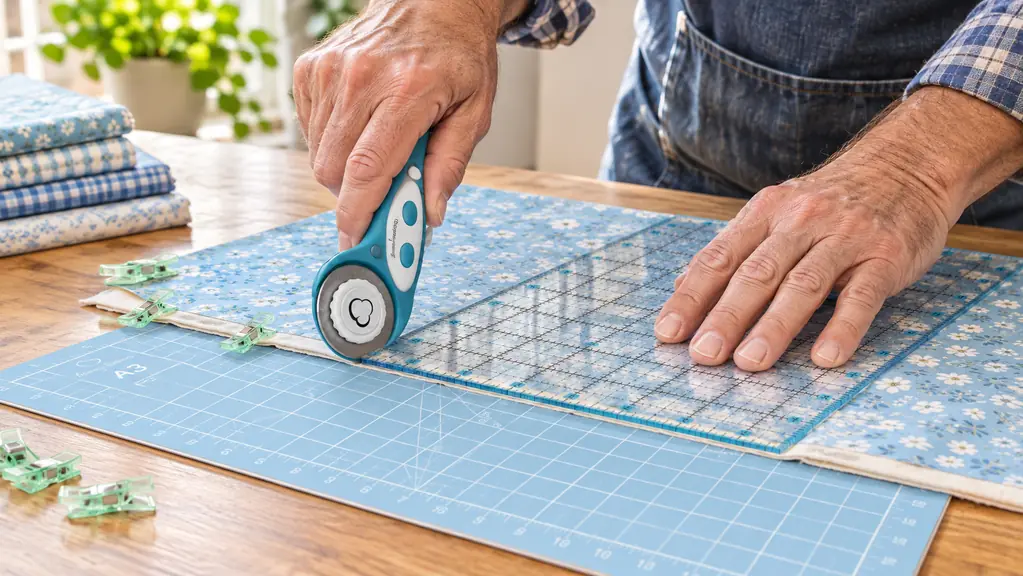
The box is a working kit, not a sampler. You get the 45mm rotary cutter, five replacement 45mm blades, the A3 self-healing cutting mat, an acrylic ruler and craft clips. The cutter has a stainless steel handle and an ergonomic grip with an adjustable screw system. That screw is the part I care about. A rotary blade that wobbles will skip at the corner of a pattern piece, and a blade that is seated firmly cuts a line you can trust. The SKS-7 steel blades are the other half of that equation, because a sharp blade needs less pressure and leaves a cleaner edge.
The mat measures 18 by 12 inches, with a printed grid of 16 by 10 inches and a thickness of 3 mm. The self-healing surface has closed up after every cut I have made, including a few where I pressed harder than I should have. The 3 mm thickness is worth understanding. It is portable and it lies flat on my cutting table, but it is not a deep cushion. I keep the whole mat supported, not hanging over the edge, and it has stayed flat. If you cut on a table with a seam or a rough spot, put a large board underneath the mat first.
The acrylic ruler is clear enough to see the fabric underneath, and the craft clips are useful for holding folded layers or keeping a pattern piece from shifting. I would not call the clips the reason to buy the set, but I have used them more than I expected when I was cutting binding and small facings. The ruler is the quiet helper in the kit. It lets me check a seam allowance without moving the fabric, and it gives me a straight edge for squaring up a pocket bag or a waistband.
In the hand, the cutter feels more substantial than the plastic cutters I have borrowed from friends. The stainless steel handle and the 1.02 kg kit weight give it a settled feeling on the table. That matters when you are cutting a long curve and you do not want the tool to skate. The handle is not so heavy that my wrist tires, but it is not a featherweight either. I can cut for an afternoon with breaks and not feel like I have been gripping a pencil too hard.
Cutting Fabric on the A3 Mat: Where It Shines and Where It Doesn't
The Honey's Heaven Rotary Cutter Set is at its best on curves, small pieces and repeated shapes. Collar stands, cuffs, pocket bags, bias strips, facings and neckline curves all cut faster with the rotary cutter than with shears. I can keep the fabric flat on the mat, roll the cutter through the curve and move on. The 45mm blade is a good middle size for garment sewing. It is small enough for a neckline and large enough for a straight seam, and it gives me more control than a larger blade would on a tight curve.
The mat is the limiting factor. An A3 mat is 18 by 12 inches. That is fine for a child's dress, a camisole, a collar or a patch pocket. It is not fine for a long skirt panel, a wide leg trouser piece or a full bodice front cut on the fold if you want to keep the whole piece flat. I folded and repositioned fabric for the wool skirt, and I checked the grainline twice. The printed grid of 16 by 10 inches helps, but it does not make the mat bigger. You can cut a large piece on a small mat, but you will do it in stages, and stages are where grainlines drift.
For someone who mostly quilts or makes small garments, that trade is easy. For a dressmaker who cuts long seams and large panels, the set works as a second cutting surface for detail work, not as a replacement for a full-size table mat. I still use shears for the big pieces and the rotary cutter for everything with a curve. That division of labor has held up over months of use. The cutter has not replaced my shears, but it has changed which tool I reach for first when a pattern piece has a neckline or an armhole.
The mat also has a practical limit with bulky fabrics. A 3 mm mat and a 45mm blade are not the right combination for heavy coating or multiple layers of denim. The blade will go through, but you will feel it, and the edge will dull faster. For mid-weight cotton, linen, ponte and lightweight wool, the set is comfortable. For a winter coat, I would use shears or a larger rotary setup with a deeper mat.
Blade Changes, Maintenance and the Screw That Matters
A rotary cutter is only as good as its blade. The Honey's Heaven set uses SKS-7 steel blades, and it comes with five replacement 45mm blades. I change a blade when it starts skipping instead of cutting, or when I have to press down to get through a seam. That is the honest signal. A dull blade is more dangerous than a sharp one because it makes you push harder and lose control. I keep the spare blades in the box, away from moisture, and I mark the old blade with a piece of tape before I put it in the bin.
The adjustable screw system is simple and useful. I loosen it to change the blade, seat the new blade, and tighten it until the blade is stable without being so tight that it drags. I check it before a long cutting session. The stainless steel handle has stayed comfortable during an afternoon of cutting, and the kit weight of 1.02 kg keeps the mat and tools from feeling flimsy on the table. The screw has not stripped, and the blade has not shifted sideways in use.
The mat needs very little care. I brush off lint and thread, keep it flat and avoid leaving it in a hot car or against a radiator. The self-healing surface has handled repeated cuts without a deep gouge. The 3 mm thickness means I do not treat it as a pressing pad. It is a cutting mat, and I keep the iron on the other end of the table. I also store the mat flat rather than rolled, because a mat that has been curled can take a while to settle.
The acrylic ruler and craft clips are simple tools, but they earn their place. The ruler is my straight edge for checking a seam allowance after a cut, and the clips hold a folded edge when I am cutting binding. I have not lost a clip yet, which is more than I can say for some other notions in my sewing room. The kit is not fussy, and that is a virtue in a cutting tool.
How It Compares With Shears and With a Bigger Setup
Compared with fabric shears, the rotary cutter wins on speed and accuracy for curves and small pieces. You do not lift the fabric as much, so the pattern piece stays where you put it. The trade is that you need a mat, and the mat size decides what you can cut. Shears still win for long, straight panels and for any fabric that is too thick or too unstable for a 45mm blade. I have not stopped using my shears. I have stopped using them for every curve. That is the honest change in my sewing room.
Compared with a larger rotary setup, this kit is more portable and more complete for a first buy. You get the cutter, blades, mat, ruler and clips in one go, and the A3 mat fits on a spare table or can be put away. The trade-off is the 18 by 12 inch surface. If you already own a large mat, the cutter and blades are the useful part of this set. If you are starting from nothing, the set gives you a working station without a second shopping trip.
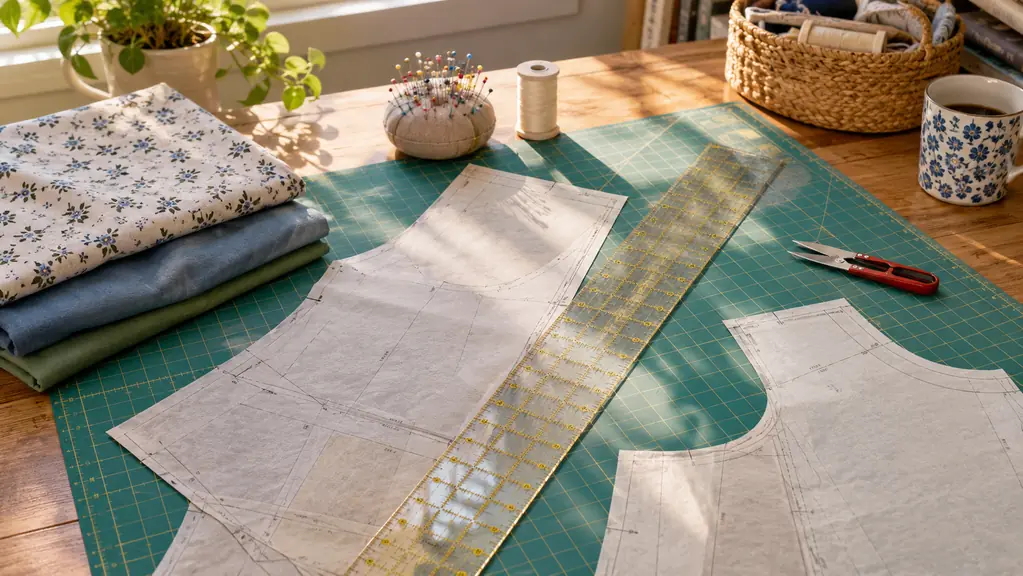
I have also used the cutter on pattern paper, which is not its main job but is useful when I am tracing a size between two pattern lines. The 45mm blade follows a curve on paper more cleanly than my shears, and the mat protects the table. I would not buy the set only for paper, but it is a pleasant extra. For fabric, the comparison is simple. The cutter is faster on curves, the shears are faster on long straight runs, and the mat decides how much of each you can do in one pass.
What I Liked
- Cuts clean curves on cotton, linen and ponte knit without lifting the fabric
- Adjustable screw system keeps the 45mm blade stable
- Five replacement SKS-7 steel blades included
- A3 self-healing mat, acrylic ruler and craft clips make a complete starter kit
- Stainless steel handle stays comfortable through a long cutting session
Where It Falls Short
- A3 mat is too small for long skirt panels and wide trouser pieces
- 3 mm mat is thin enough that it needs full support on the table
- Heavier fabrics dull the blade faster, so replacement blades matter
- The craft clips are useful but not the reason to choose the set
The cutter handled every curve I gave it. The 18 by 12 inch mat decided which pieces I could cut in one pass.
Who This Is For
This set suits a home dressmaker who cuts curves, facings, collars and small pattern pieces often and wants a complete rotary station without hunting for a mat and blades separately. It suits someone sewing for several body shapes because the cutter makes it easier to true a neckline or re-cut a seam allowance after a fit change. It also suits a quilter or crafter who works on a table that cannot hold a large mat. If you sew garments for yourself, a daughter or a granddaughter and you are tired of pinning every curve, the Honey's Heaven set is a sensible place to start.
Who Should Skip It
Skip it if most of your sewing is long panels, wide skirts or tailoring with heavy wool and you want to cut the whole piece flat in one pass. The A3 mat will frustrate you, and you would be better served by a larger mat with this cutter as a detail tool. Skip it if you already own a 45mm cutter and a mat you like, because the extra blades and clips may not be enough to justify a second set. And skip it if you expect a 3 mm mat to double as a pressing surface or a deep cushion. It is a cutting mat, and it does that job well.
If your curves are the problem, this is the fix
The Honey's Heaven Rotary Cutter Set gives you the 45mm cutter, five replacement blades, the A3 self-healing mat, an acrylic ruler and craft clips. Use it for the pieces that fight shears, and keep your big mat for the long panels.
Amazon View the Honey's Heaven Set on Amazon →