Every few weeks somebody asks me the same question over my cutting table: do I really need a rotary cutter when I already own three decent pairs of shears? My answer is dull and true. They cut different things. A rotary cutter rolls a steel blade along a straightedge and never lifts the cloth off the table. Shears lift, squeeze and release, which is exactly why they can follow a neckline that a rolling blade cannot. Honey's Heaven puts the cutter, a self-healing mat, an acrylic ruler, five spare blades and a few craft clips in one box, and after a full winter of cutting with it I can tell you where it earns its space and where my shears still get the job.
So here is the short answer. If your cutting is mostly straight lines, rectangles, strips, waistbands, facings and eight identical sleeve heads, the rotary cutter wins and it is not close. It goes through several layers at once, it holds its line because the blade runs against the ruler, and every piece comes out the size of the one before it. If your cutting is curves, armscyes, notches, clipping a seam allowance that is still on the dress form, or trimming something balanced on your knee, shears win. A rolling blade only goes where the ruler lets it go.
| Honey's Heaven Rotary Cutter Set | A Pair of Fabric Shears | |
|---|---|---|
| Straight lines and rectangles | Blade runs against the ruler, so the line stays true | You draw the line first and follow it by eye |
| Cutting several layers at once | Goes through a stack with even pressure | Two layers before the cut starts to wander |
| Curves and tight corners | Only as tight as the ruler allows | Turns in the hand, follows a drawn curve |
| Notching and clipping seams | Not practical, the blade would run past the notch | One snip at a time, exactly where you meant |
| Trimming a garment that is already assembled | Wants the piece flat on the mat | Works on a dress form or across a lap |
| Repeatable accuracy over many pieces | Identical pieces once the ruler is set | Accuracy drifts as the stack grows |
| Slippery fabrics | Nothing gets lifted, so nothing shifts much | The cloth moves as you lift it to cut |
| Space in a small sewing room | Wants a flat surface for an 18 by 12 inch mat | Lives in a drawer |
| Upkeep | Blades are replaced, not sharpened | Needs sharpening, or a new pair eventually |
| Best for | Straight cutting in volume | Shaping and fitting |
Where the Honey's Heaven Rotary Cutter Set Wins
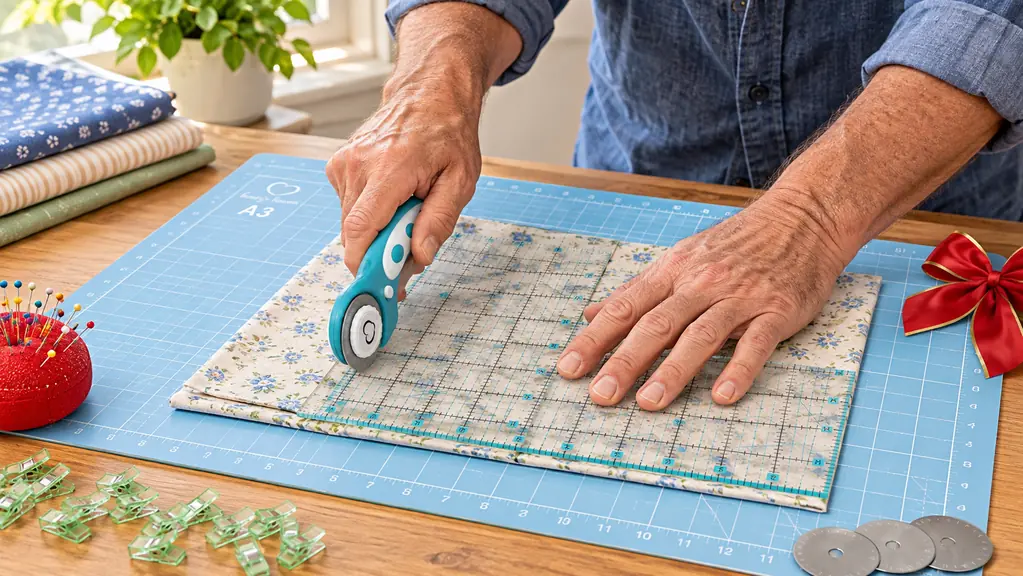
Straight cutting in volume is where this set separates itself. Last month I cut eight waistband pieces and four pocket bags from a mid-weight cotton in about the time it used to take me to trace and cut two. You lay the cloth flat on the mat, set the acrylic ruler where the line belongs, and roll. The cut is straight because the ruler is straight, not because your hand is steady, and that difference matters more every year. My hands are fine. They are also sixty-one years old, and they behave far better against a ruler than they do following a pencil line across a metre of fabric.
The second benefit is repetition, and nobody talks about it enough. Cut four of the same piece with a rotary cutter and a ruler and all four match. Cut them with shears and the first is accurate, the third is close, and the fourth is the one you will be trimming later, after it is sewn and pressed and hanging in front of you. The handle has an adjustable screw system that keeps the blade firm, so there is no wobble halfway along a long cut, and the mat under the cloth gives the blade something to bite without dulling it against a tabletop. Five spare blades sit in the box. I have not needed one yet. I still like knowing they are in the drawer.
Here is the job that made the case for me. In January I cut the binding for a quilted jacket, twenty-four strips at two and a half inches wide, from a length of cotton that wanted to slide off the table every time I touched it. With shears that is a drawn line, a careful lift, and a strip that comes out a little wide at one end. With the mat and the ruler it is a folded stack, a mark on the ruler, and twenty-four strips that all match each other. It took about twenty minutes. The same job used to eat an afternoon and leave me grumpy.
Where a Pair of Fabric Shears Wins
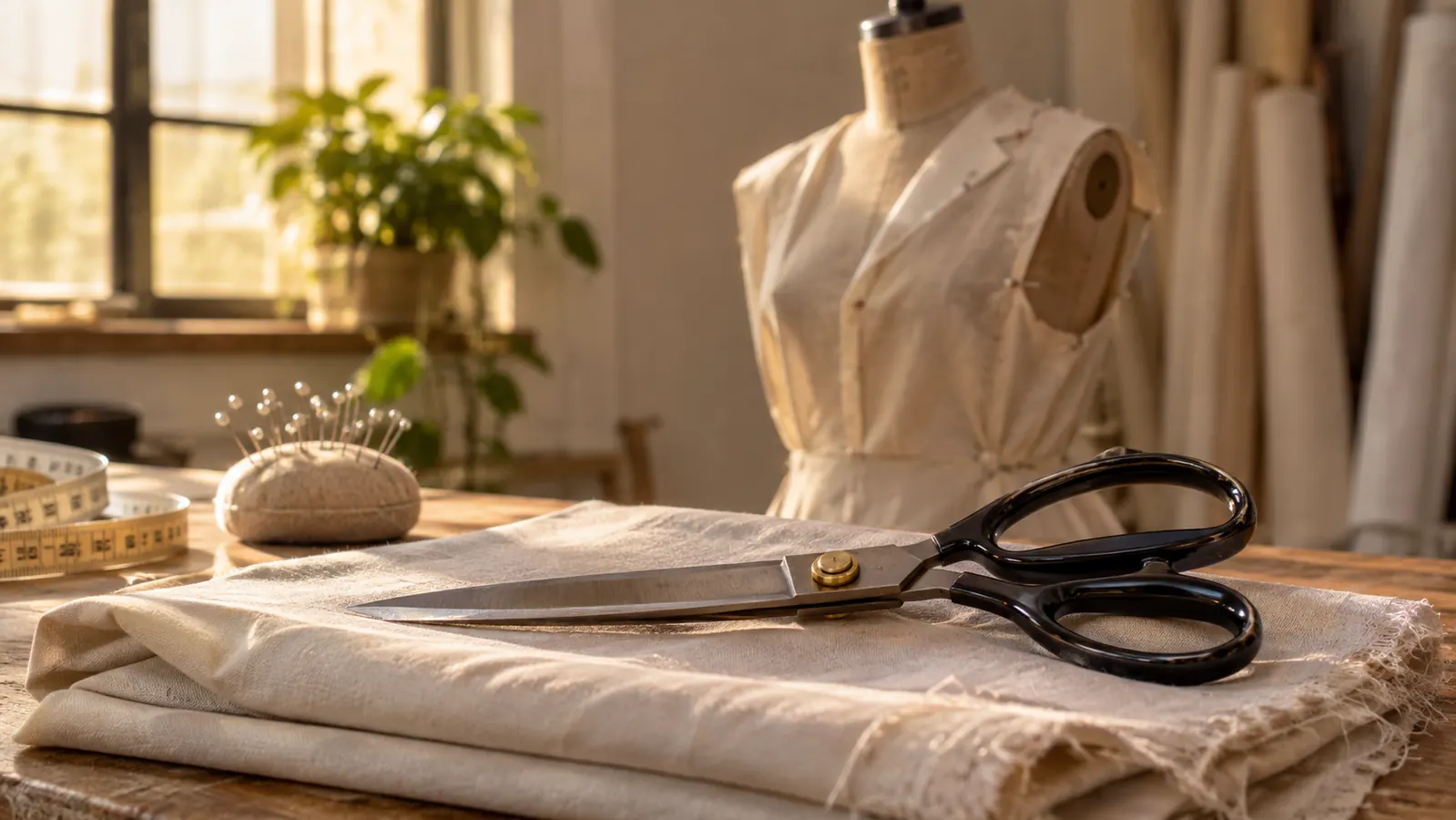
Curves, and I will not pretend otherwise. An armscye, a neckline, a curved pocket facing, a princess seam, none of those are jobs for a rolling blade. A rotary cutter follows the path the ruler allows, which means long gentle curves at best and nothing at all for a tight one. Shears turn in your hand. You can start at a notch, follow a drawn line, and stop exactly where you intended to stop. The same goes for clipping a seam allowance so it presses flat, or notching the curve of a collar. That work is one snip at a time and it always will be, no matter how good the blade is.
Shears also win anywhere the garment is not lying flat on a table. I fit on my grown daughter and on my granddaughter, and both of those involve trimming a seam while the piece is on a body or on the dress form. You cannot roll a cutter along a shoulder that is standing up in front of you. Same for a hem you are levelling while the wearer turns slowly on the spot. And in a small sewing room, shears live in a drawer and come out when you call them. The mat needs a flat surface and it needs to stay flat, which is a commitment scissors never ask of you.
If your cutting is mostly straight lines, this is the box that ends the tracing
Cutter, mat, ruler, five spare blades and clips in one set. The ruler keeps the blade honest and the mat keeps it sharp.
Amazon Check Today's Price on Amazon →What Is Actually in the Box
The Honey's Heaven box is a kit rather than a single tool, and that is the part to understand before you compare it to a pair of shears. You get the 45mm rotary cutter, five replacement blades, an A3 cutting mat, an acrylic ruler and a small set of craft clips. The whole set weighs about 1.02 kg. The handle is stainless steel with that adjustable screw, and the blades are SKS-7 steel.
The mat is 18 by 12 inches, which is A3, and the printed grid inside it measures 16 by 10 inches. It is 3 mm thick and it is self-healing, meaning the blade parts the surface and the surface closes over again instead of leaving a trench where you always cut. The acrylic ruler is the straightedge the blade runs along. The craft clips hold folded layers together where you would otherwise reach for pins, and pins are the one thing you must never roll a blade across.
The Mat Is the Part People Underestimate
Buy a rotary cutter without a mat and you will be disappointed, and you will blame the tool. The mat is what makes the cut work. It gives the blade a surface that yields slightly so the edge stays sharp, and it holds the cloth still while both your hands are busy with the ruler. Try this on a bare tabletop and you will blunt a blade in an afternoon and wonder what you did wrong. The answer is nothing dramatic. You simply cut into wood for two hours.
I did exactly that once, before I owned a mat. I cleared the kitchen table, laid the cloth over a couple of old towels and rolled. It worked for about an hour. By the third hour the blade was dragging, the towels had a groove worn through them, and I blamed the cutter, which was a cheap one and probably deserved part of the blame. The second attempt, on a real mat with a blade that had never touched a pin, was a different tool altogether. Same hands, same cloth, entirely different result.
The A3 size is a real limit and I would rather say so out loud. Eighteen by twelve inches is generous for pattern pieces, strips, facings and pocket bags, and cramped for a whole skirt panel. I cut the big pieces in two passes, or I fold and cut on the fold the way I would with shears. If your sewing is mostly full-length panels, the mat will feel small. If it is bodices, waistbands and clothes for a growing teenager, it is plenty and then some.
The mat is not an accessory. Without it a rotary cutter is a very sharp wheel with nowhere to go.
Blades, and the Habit That Ruins Them
A rotary blade is not sharpened, it is replaced. That sounds wasteful until you weigh it against sending a good pair of shears out to be sharpened and doing without them for a week. It is also the easier habit: loosen the screw, lift the old blade, drop in the new one, tighten it back down. Five spares come in the box, and at the rate I cut, that will last me a good while yet.
I keep the date on the blade with a strip of masking tape on the drawer front, which sounds fussy and has saved me more than one argument with myself. A blade lasts me somewhere around four months of steady cutting. Less if I have been working denim or canvas, more if it has been mostly cotton and lining. Denim is what tells you the truth about a blade, because it fights back from the first layer and the cutter will start needing two passes long before your cotton projects would have shown you anything.
The habit that ruins a blade is cutting across pins. One pin nick takes a bite out of the edge, and after that the cutter skips instead of slicing, no matter how many layers you feed it. The craft clips in the set exist so you do not need pins anywhere near the cut line. The other habit is pressing too hard. Let the blade do the work and keep the pressure even along the whole stroke. If the cutter suddenly needs two passes, the blade is dull. The fabric has not changed. The blade has.
Using Both on the Same Garment
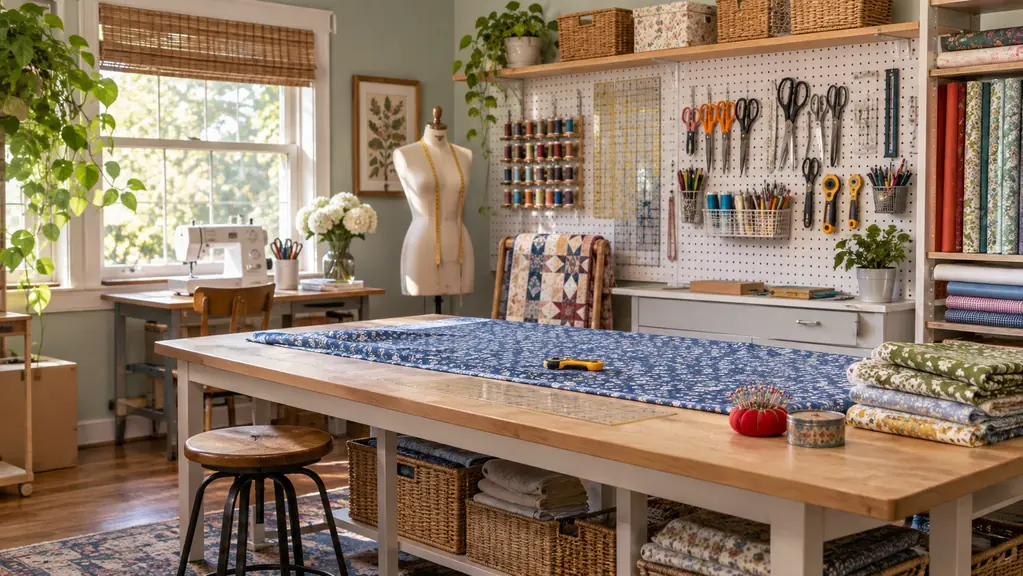
This is what my table actually looks like on a cutting day. The mat sits square at the front edge, ruler and cutter on top of it, shears at my right hand, clips in a bowl. I cut the straight pieces with the rotary cutter first, all of them, while the cloth is folded and flat and the ruler is already set. Then the shears come out for the curves, the notching, and anything that needs shaping on the form.
Last spring my granddaughter wanted a dress for a school evening, and I cut it over two sittings. The bodice and the waistband went under the rotary cutter, the whole lot of it, because bodice pieces are small and there are a surprising number of them once you count the facings. The skirt was a soft viscose that moves if you look at it, and I cut that in two passes with the mat, weighting the selvedge with a spool of thread. The armscyes came off with shears, one careful pass each, because no ruler in my drawer will turn a corner that tight.
Nine times out of ten the order matters. If you shape the curved edges first and then try to cut straight strips, the piece will not sit flat on the mat any more and the ruler has nothing to register against. Straight first, curves second. That also keeps the blade away from the sections you have already clipped and pinned, which is how you keep a blade alive for months.
I also use the shears to check the rotary cutter's work, which sounds paranoid and is not. A straight cut that looks true on the mat can be a thread off once the piece is pressed and hanging. Trimming a thread off a seam allowance with shears takes five seconds. Redoing a waistband takes an evening.
Who Should Buy Which
If your sewing is mostly garments cut from flat pieces, and you cut the same shape more than once, the Honey's Heaven set will earn its space on the table. It suits anyone making multiples, cutting strips, or working through a pattern with a lot of straight seams, and it suits anyone whose accuracy drifts once they are tired. Keep the shears next to it for curves and for fitting. If you mostly alter and mend, shape clothes that already exist, or cut on the floor with the fabric across your knees, a good pair of shears is still the whole answer and the mat will end up behind a door. Most of us land on both, and I do not think that is a lack of discipline. It is just how the work divides.
Two tools, one cutting table, and a set that covers the straight half of the job
Start here if volume and repeatability are your problem. Reach for the shears when the line starts to curve.
Amazon See the Honey's Heaven Rotary Cutter Set on Amazon →