
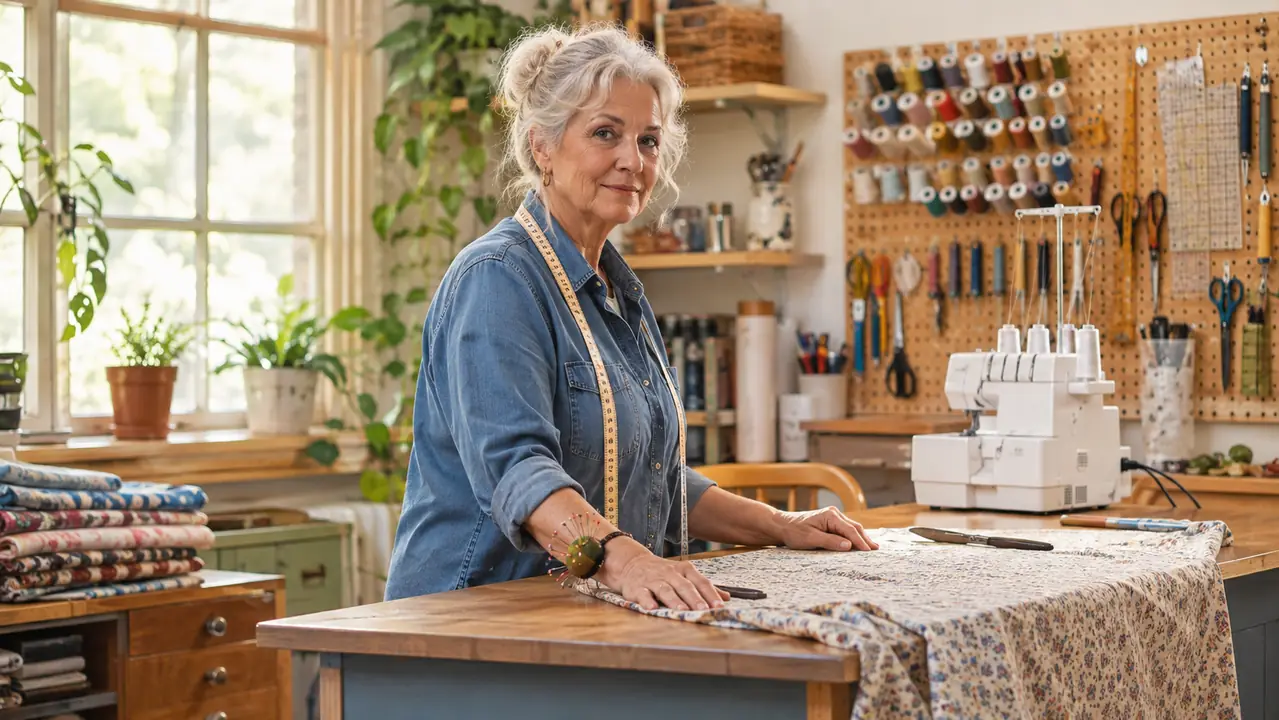
The first thing I serged on the Brother 1034D was a scrap of jersey knit, and it came out looking like a ruffled ribbon. I had the fabric lined up, I pressed the foot pedal, and four threads turned a flat piece of cloth into a wave. There is no backstitch to lock the end of a serged seam, and the thread path is nothing like the one your fingers already know by heart. The machine will also keep eating fabric while you stand there deciding what went wrong. That was a Saturday in my sewing room, the converted spare bedroom with the long cutting table and the pegboard wall, and I spent the rest of the afternoon with the manual open on my knee.
Here is the honest version, the one I wish someone had handed me before I bought it. The Brother 1034D is a good machine. It will make the inside of your clothes look like the inside of the clothes you buy in a shop, and it will do it in a fraction of the time a zigzag edge takes. It is also a machine with opinions. It wants to be threaded in a particular order, it wants fabric fed at a particular pace, and it complains in loops and puckers when you ignore it. None of that is a fault. But you should hear it from a person before you hear it from your own seam ripper.
The Quick Verdict
A four-thread workhorse with a metal frame that will outlast your patience for learning it. Set aside the first month for lessons, not production.
Amazon Check Today's Price →A machine that rewards the person who reads the manual
The Brother 1034D runs three or four threads, sews up to 1,300 stitches per minute with the foot pedal, and ships with the instruction manual you will genuinely need. The full listing is the place to start.
Amazon Check Today's Price on Amazon →The First Thing Nobody Tells You: It Does Not Replace Your Sewing Machine
The thing nobody tells you first is that a serger does not replace your sewing machine, and the Brother 1034D is no exception. It finishes edges. It trims the seam allowance as it goes and wraps the raw edge in thread so the fabric cannot ravel, which is the whole reason the inside of a garment stops looking homemade. Everything structural still belongs to your regular machine: the darts, the zipper, the shoulder seams, the hem you want to be invisible. If you buy this expecting to sew an entire dress on it, you will be disappointed by Thursday.
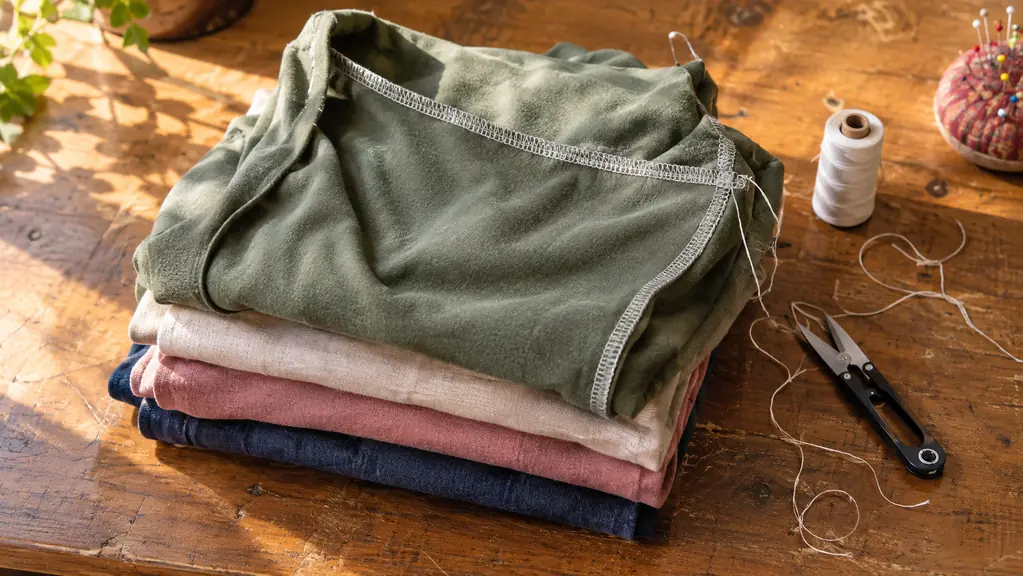
I construct every garment on my old machine and carry it to the serger at the end. That order has not changed in all the years I have been sewing. What changed is how the finished piece wears. A serged seam on a knit top survives the wash cycle that turns a zigzagged seam into a frayed mess, and the shoulder line on a linen dress stops shedding threads onto the wearer. If you have spent years altering clothes for friends and neighbours, as I did, that is the difference they notice without being able to name it.
So the decision is not serger instead of sewing machine. It is serger in addition to the machine you already trust. Once you accept that, the rest of this review is about what the Brother 1034D does well, what it does not, and which of its quirks are worth learning around.
How I Have Used It
I sew for three people with three completely different shapes: myself at sixty one, my grown daughter, and a teenage granddaughter who seems to add an inch every season. That mix is why I care about finishing more than I care about speed. When a garment has to be let out, taken in, or handed down, a seam that raveled the first time cannot be rescued twice. The Brother 1034D has been the machine at the end of that chain. Roughly four years now, most weeks, on everything from jersey tops to a wool coat I did not fully think through.
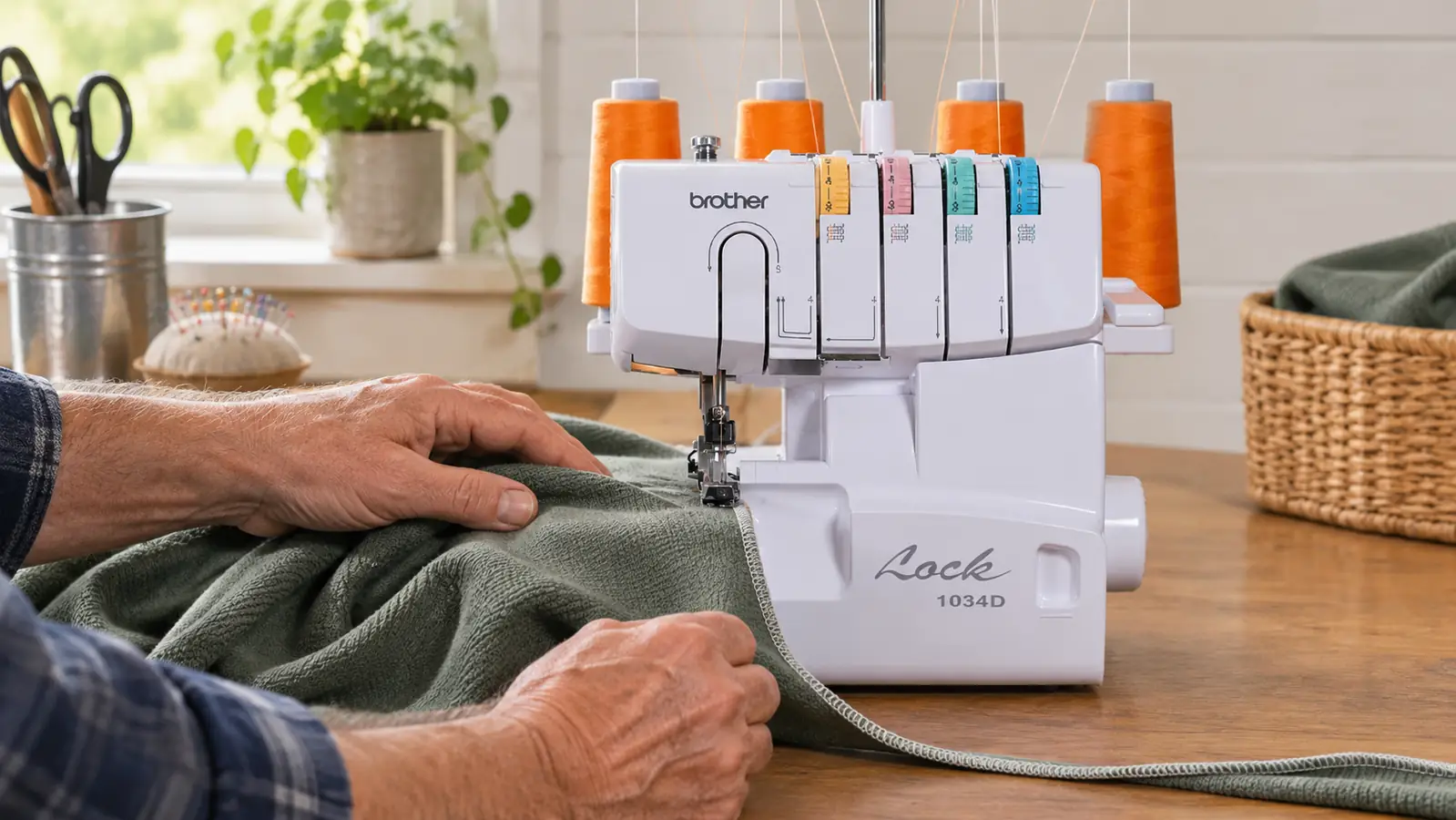
What it handles without complaint is thickness. I have run folded denim seams through it, four layers at the thickest point, and it did not stall, skip, or make the grinding noise that tells you a motor is negotiating with you. The listing says it handles multiple layers of denim and other heavy materials, and my experience matches the listing, which is not something I say often. At the other end, a single layer of fine voile is where you have to slow down and pay attention, because the machine will over-trim a narrow seam allowance before you have decided you wanted it narrower.
The size is the other thing I appreciate. It weighs eight pounds and takes up about eleven inches of width, thirteen of height and ten of depth, so it sits permanently at the far end of my cutting table and gets lifted onto a shelf only when I need the whole surface clear. A machine I have to unpack is a machine I stop using. This one never needs unpacking.
Threading, Honestly
The Brother 1034D uses a color-coded upper thread guide and a lower looper threading system, and the color coding does more work than I expected it to. The first time I threaded it, it took me about forty minutes, with the manual flat on the table and my reading glasses pushed up on my head. The second time, twenty. These days it is closer to six minutes if nothing goes wrong, and I want to be honest with you that something still goes wrong maybe one time in ten.
The lower looper is the part that humbles everyone. You reach underneath, you are working partly by feel, and the thread has to travel in a specific order or the machine will produce a beautiful chain of loops attached to nothing. The instruction manual is included in the box, and I want to be direct with you: keep it. Not in a drawer in another room. On the table, where you can put a hand on it. I have sewn for decades and I still consult mine when I change thread weights and something starts chirping.
There is a habit that saves the most time once you know it, and it appears in no listing I have ever read. You do not have to re-thread from scratch every time you change colour. You clip the old thread near the spool, tie the new one to it, and pull the old one through until the new one appears at the needle. It works, it takes a minute, and it is the difference between changing thread as a chore and changing thread as nothing at all.
Forty minutes the first time, six the last time, and I still check the lower looper twice before I press the pedal.
Tension, and the Quirks Nobody Mentions
Tension is the part that separates people who love their serger from people who sell it in month three. It is not a setting you find once and forget. It is a conversation you have with each fabric, and the machine answers in loops. A puckered seam means one thing, a loop hanging off the edge means another, and a thread snapping halfway along a long seam usually means you were asking too much of it. When something looks wrong, the answer is almost never a different machine. It is usually a re-thread and a slower foot.
The pedal is the whole story with speed. The Brother 1034D sews up to 1,300 stitches per minute, which is a number I have never once needed. For the first two weeks I do not think I got above a crawl, and a crawl is correct. Learning a serger at full speed is like learning to drive on a hill. There is a reason the foot pedal is the only thing between you and the machine, and it rewards a light touch rather than a confident one.
The quirks are small and they are constant. It trims as it serges, which means errors become confetti faster than you can react, so you do not serge over pins and you do not serge a seam you have not checked twice. Every seam begins and ends with a chain of thread you have to run off and cut, and after a while you own a jar of them and have no use for them. It is also louder than a sewing machine. Not unpleasant, but if you sew at night after the house has gone quiet, everyone will know.
One more thing nobody says out loud: the machine is quick enough that you can clear a whole basket of mending in an evening, and that changes your habits. I mend now. Things I would once have folded into a bag for the charity shop get a finished edge and another two years of wear, and my daughter has stopped asking whether something is worth fixing.
The last quirk is the one that matters most to anyone who sews for other people. A serged seam is difficult to unpick. You cannot simply rip it out and start again, because the edge has already been cut. That is a real cost of working this way. It makes you a more careful cutter and a more deliberate sewer, and it took me a full season to stop resenting it.
What I Liked
- Three or four thread overlock with a metal frame and metal interior components
- Runs multiple layers of denim without stalling or skipping
- Color-coded upper thread guide and lower looper system make threading learnable
- Foot pedal gives genuine speed control up to 1,300 stitches per minute
- Eight pounds, eleven inches wide, small enough to leave out on the table
Where It Falls Short
- The first month is lessons, not production
- Five years on parts but only ninety days on labor
- The included thread is starter thread, not keeper thread
- It finishes edges; it does not construct a garment
- It trims as it serges, so mistakes cannot be undone
What Comes in the Box, and the Fine Print
In the box you get four large spools of serger thread, a soft cover, and an accessory bag with needles. The thread is enough to learn on and to practise tension on. It is not the thread you will still want in a year, and I would not plan a garment you care about around it. The soft cover is more useful than it sounds, because a serger gathers lint along the thread path and a cover keeps some of it out.
The warranty is five years limited on parts and ninety days on labor, and I want you to read that slowly. Five years on parts is a real commitment. Ninety days on labor is not. If something goes wrong in month five, you may be the one diagnosing it, or paying someone, or shipping the machine away. That is not a reason to avoid the Brother 1034D, since it is a common arrangement at this level. It is a reason to register the machine and keep the receipt somewhere you will actually find it.
The frame and interior components are metal, which is why the machine feels settled rather than tinny when you press the pedal. It runs on household current at 120 volts and it is corded, so plan an outlet at the end of the table rather than an extension cord stretched across the floor. No battery, no charging ritual, nothing to remember.
Who This Is For
This machine suits someone who already has a sewing machine they trust and has started to notice that the inside of their garments does not match the outside. If you sew knits, if you sew for children who outgrow things, if you alter clothes for other people, a serger turns a chore into a two minute step. It also suits anyone willing to spend the first month being bad at something. That willingness matters more than natural talent, and I say that as a woman who once threaded a lower looper backwards eleven times in one evening.
It is a good fit for a home dressmaker who wants a four thread overlock with a metal frame, real speed control under the foot, and a footprint small enough to leave out permanently. And it is a good fit for someone who reads instructions. The manual is the difference between a fortnight of misery and an afternoon of confusion.
Who Should Skip It
Skip it if you do not yet have a sewing machine, because this will not do the job you actually need done. Skip it if you want to sew a garment start to finish on one machine. Skip it if you are buying it in the week before a deadline, since the learning curve is real and the machine cannot be hurried through it. And skip it if nobody in your house is willing to hear a machine run at nine in the evening.
Skip it, too, if you only ever sew stable wovens with generous seam allowances and you are perfectly happy with a zigzag finish. A serger earns its place when you are fighting fraying, working with stretch, or finishing for someone else. If none of those is true, the machine will sit under its soft cover and you will feel guilty about it. I say that as someone who also owns a bread maker.
If you have read this far, you already know whether it is for you
Three or four threads, a metal frame, up to 1,300 stitches per minute under a foot pedal, and a manual worth keeping on the table beside you. The first month is lessons. After that it is the quietest improvement you can make to the inside of a garment.
Amazon Check Today's Price on Amazon →