Every few weeks someone in one of my sewing groups asks whether the Brother 1034D will do coverstitching. It will not. It was never meant to. And the fact that so many of us ask tells you how badly the two jobs get muddled: a serger and a coverstitch machine both have loopers, both look like they escaped from a factory floor, and both sit to the right of your regular machine. After that the resemblance falls apart.
A serger, and the Brother 1034D is a good one, trims the seam allowance, wraps the raw edge in thread, and sews the seam all at once. It gives you the inside of a t-shirt. A coverstitch machine gives you the outside of a t-shirt: the two parallel rows of stitching across the hem of a knit dress, the ones that stretch and snap back. One is about what happens inside the garment. The other is about what the world sees. I have sewn on both for years, mostly for myself and for a daughter and granddaughter who have three completely different shapes, and I would not give up either. But if you can only buy one right now, the answer depends entirely on what you sew.
If your problem is raw, fraying seam allowances, this is the machine that fixes it
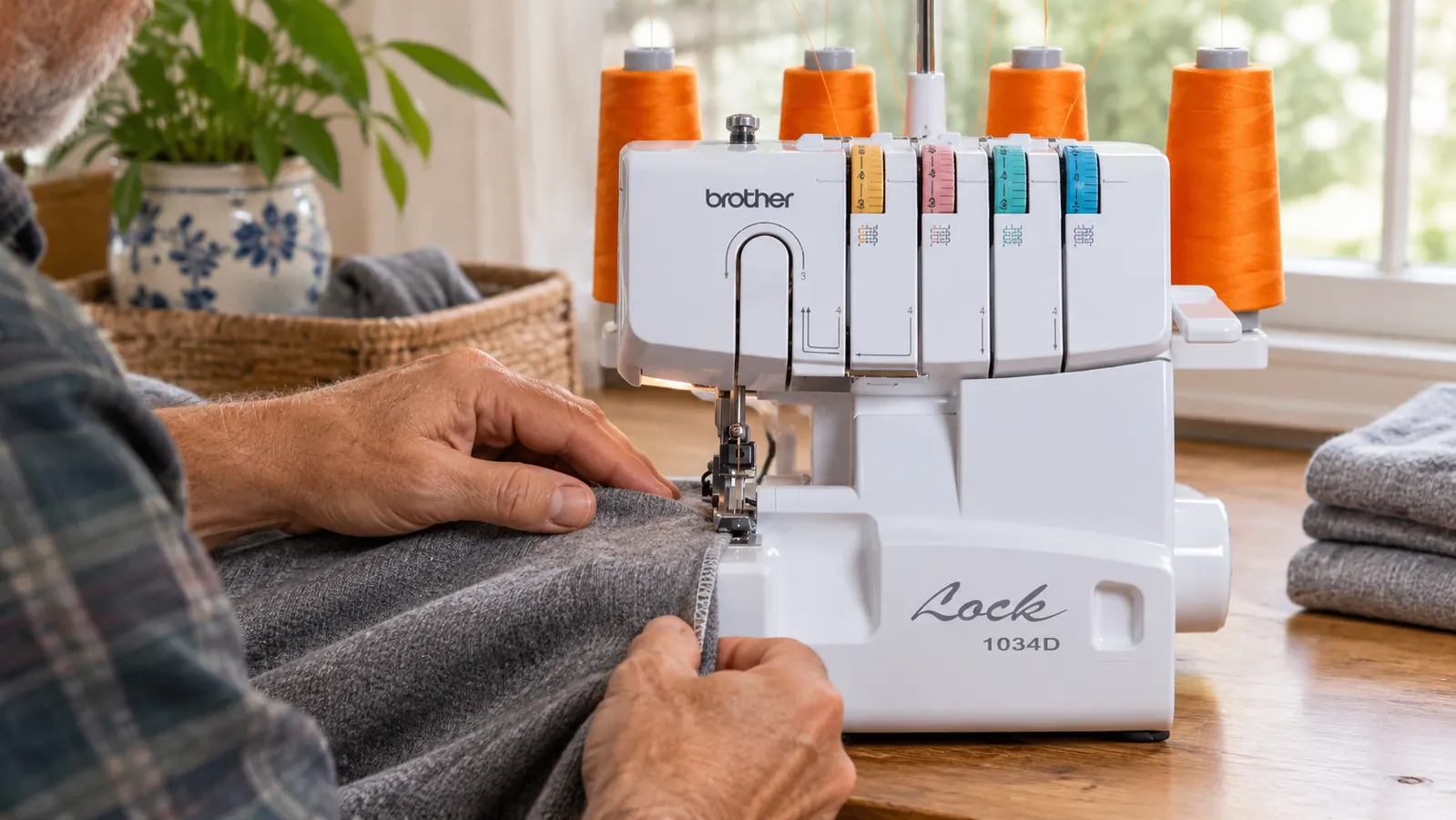
The Brother 1034D handles up to four threads, sews through multiple layers of denim, and finishes an edge in one pass. It is the workhorse under most of what I make.
Amazon Check Today's Price on Amazon →The Short Answer
If you sew mostly wovens, if you make anything with facings and darts and a lot of fabric edges to contain, buy the serger first. If you sew mostly knits and the thing that keeps ruining your finishes is the hem rather than the seam, a coverstitch machine is the tool you are actually missing, and no amount of serger practice will substitute for it.
The order I would buy them in, for most people reading this: serger first, coverstitch second. The serger earns its bench space on nearly every garment. The coverstitch earns it on maybe half. You can make a respectable knit dress with a serger and a twin needle on your regular machine. You cannot make one with a coverstitch machine and no way to finish seams.
| Brother 1034D | Coverstitch machine | |
|---|---|---|
| What it does | Trims the seam allowance, overcasts the raw edge and sews the seam in one pass | Hems, binds and topstitches with parallel rows of stretch stitching, no trimming |
| Best on | Every fabric you own, from cotton lawn to multiple layers of denim | Knits and stretch fabrics, plus decorative topstitching on wovens |
| Seam allowance | Trims it as part of the process, so the finish is clean without extra steps | Does not trim anything, so you still need a way to contain raw edges |
| Stitch count | 3 or 4 thread overlock, plus a rolled hem | Usually 2, 3 or 5 thread coverstitch, a completely different stitch structure |
| Threading | Color-coded upper guides and lower looper path, with a manual that walks you through it | Generally more involved, more thread paths to get wrong |
| Footprint and weight | 10 by 11 by 13 inches, 8 pounds, sits easily at the end of a cutting table | Usually larger and heavier, needs real estate of its own |
| Sound and speed | Up to 1,300 stitches per minute, foot pedal control | Comparable speed, but more mechanical fuss per stitch |
| Stretch recovery on a hem | Not what it is for | Exactly what it is for, and nothing else does it as well |
| Where it belongs in your room | Out and threaded at all times, used on almost every project | Out when you are making knits, covered the rest of the year |
Where the Brother 1034D Wins
It wins on frequency. I cannot think of the last garment I made that did not go through the serger at some point. Woven blouses, my granddaughter's school skirts, the lining of a jacket, a plain cotton tote for the farmer's market. Every one of them had raw edges that needed containing, and the fastest, most durable way to contain them is an overlock stitch. The machine has a metal frame and metal interior parts, which matters more than it sounds when you are pulling folded denim waistbands through it at an angle. Last spring I made a lined linen jacket, and the lining alone had fourteen separate pieces. Fourteen pieces means twenty-eight raw edges before you even reach the seams. I trimmed each allowance down to a scant three eighths and let the serger wrap it, and the inside of that jacket is as clean as the outside. Doing the same by hand, with a zigzag or a pair of pinking shears, would have cost me an entire extra evening.
It wins on forgiveness. Four threads, up to 1,300 stitches per minute, and a foot pedal that lets me creep along a curve at a snail's pace when I need to. The color-coded threading path and lower looper are the reason I recommend this particular machine to people who are nervous about sergers at all. Threading a serger is the thing that scares everyone, and Brother made it about as clear as it can be made, with a manual that actually shows the sequence rather than assuming you know it. It also trims as it goes, which means one pass instead of three. That is not a small thing at eleven at night. And when I misjudge a neckline binding and the curve goes wrong, I can stop, ease the work back out, and start again two inches earlier. I have done exactly that on a shoulder seam more times than I will admit, and the garment survived every time.
Where a Coverstitch Machine Wins
It wins the hem, and the hem is the thing most home sewists quietly fail at for years. That twin row of stitching on a knit hem is not decoration. It is a stitch structure that stretches with the fabric and recovers. My twin needle on the regular machine approximates it from the right side and leaves a mess on the back. You can hide that mess with a strip of fusible tape if you are patient, or you can hem the way the garment was designed to be hemmed. My granddaughter wanted a jersey dress for a school dance last October, and I made it in a ponte with a bit more weight than a plain jersey. I measured a one inch hem, pressed it, and then sat there for a good ten minutes deciding what to do with it. I finished it on a friend's coverstitch machine two towns over. The difference between that hem and the twin needle hem I had done on the same pattern a year earlier was not subtle. It moved when she moved. It did not pop when she sat down.
It also wins the pieces where the stitching is the design. A banded neckline on a knit top, a decorative coverstitch across a ponte skirt panel, the flat joining seam on a sports bra. Those are not finishes you can fake with a serger and a prayer. And if you sell anything you make, or give it to a daughter who inspects the inside of everything, a proper coverstitched hem reads as professional in a way that no amount of careful pressing will. I am not going to pretend a serger can do that job, because it cannot, and anyone who tells you otherwise has not tried to wear a serged knit hem for an afternoon.
The serger is the machine I use on every garment. The coverstitch is the machine I am glad I own when the garment is a knit and the hem has to move.
The Threading Question, Because Everyone Asks
You will hear that sergers are harder to thread than coverstitch machines. In my experience it is the other way around, and it is the reason I steer first-time serger buyers toward the Brother 1034D. The threading sequence on this machine is laid out in color, upper guides and lower looper both, and once you have done it four or five times your fingers remember it. I rethread for a rolled hem maybe twice a month now and it takes a couple of minutes. The first time took an hour and involved language I will not repeat. What actually went wrong that first evening: I had the lower looper thread sitting outside the tension disc instead of inside it. Everything looked threaded. Nothing was. I chased that for forty minutes before I found it, and the entire problem was a thread a quarter inch to the left of where it belonged.
A coverstitch machine has more thread paths and less tolerance for a mistake in any one of them. When a serger is mis-threaded you usually get a loopy mess you can diagnose. When a coverstitch machine is mis-threaded you often get skipped stitches on one of the two needle rows, which is a fussier thing to chase down. Neither machine is beyond a home sewist. Both will humble you once. Just do not assume the coverstitch is the easy one because it has fewer moving parts to look at.
What I'd Tell You Before You Buy Either
Buy the machine that solves the problem you actually have, not the one that solves the problem you admire. If your finished garments look homemade because the insides are fraying and bulky, that is a serger problem and it is the more common one by far. If your garments are beautifully finished inside and the hems still look like a home ec project, that is a coverstitch problem and you already know it. Here is a test you can run tonight. Take the last three things you made and turn them inside out. If you wince at all three, buy the serger first.
And do not buy both at once, whatever the sale is doing. Learn one machine properly first. A serger you have threaded a hundred times and can set the tension on without reaching for a test scrap is worth more than two machines you are scared of. The Brother 1034D takes four large spools of thread, comes with a soft cover and an accessory bag, measures 10 by 11 by 13 inches and weighs 8 pounds, which means it fits at the end of a cutting table without taking the whole thing over. It carries a five year limited parts warranty with ninety days on labor. That is a machine you can grow into for a few years before you need the second one.
Who Should Buy Which
Buy the Brother 1034D if you are building a sewing practice rather than fixing one specific frustration. If you sew wovens, if you alter clothes for other people, if you make a garment a month and want the insides to look as good as the outside, this is your first machine and it will pay for itself in saved time on the very first jacket lining. It also handles heavy material well enough that you are not going to outgrow it the first time you make a pair of jeans. I ran a folded denim waistband through mine at four layers at the thickest point and it did not slow down. Nine years of altering for neighbours taught me that almost every garment problem people bring you is an edge problem, and an edge problem is what this machine solves.
Buy a coverstitch machine first only if you have already committed to knits. If your closet is full of jersey dresses you made yourself, if you are sewing activewear, if the hem is the last thing standing between you and clothes you would wear out of the house, then yes, get the coverstitch and keep using your regular machine with a tiny zigzag on the seam allowances until you can add the serger. That is a workable order for a knit-only sewist. For everyone else, the coverstitch is the second purchase, and it will feel like a luxury when it arrives, because it is one. The one caution I would add is that a coverstitch machine with no serger beside it means every seam inside the garment is still a zigzag, and a zigzag on a knit seam is bulky in a way you will feel under a fitted sleeve.
A Note on the Thing You'll Do Anyway
You will try to coverstitch on the serger. Everyone does. You will look at the rolled hem setting, decide it is close enough, and hem a knit dress with it. The dress will look fine on the hanger. Then you will put it on, sit down, and hear a small popping sound as the thread gives. I have made this mistake for a granddaughter's birthday dress and then remade the hem the night before. Learn from my evening of unpicking. The rolled hem on a serger is a lovely finish for a woven scarf or a lightweight linen edge. It is not a substitute for a stretch hem, and it never will be.
Sew the machine you have. Thread it, practice on scraps until the tension is right, and make something. The tools matter, but they are not the thing standing between you and a finished garment. That would be the fabric you are afraid to cut.
Start with the machine that touches almost every garment you make
The Brother 1034D trims, overcasts and sews the seam in one pass, handles four threads and multiple layers of denim, and threads through a color-coded path with a manual that walks you through it.
Amazon Check Today's Price on Amazon →