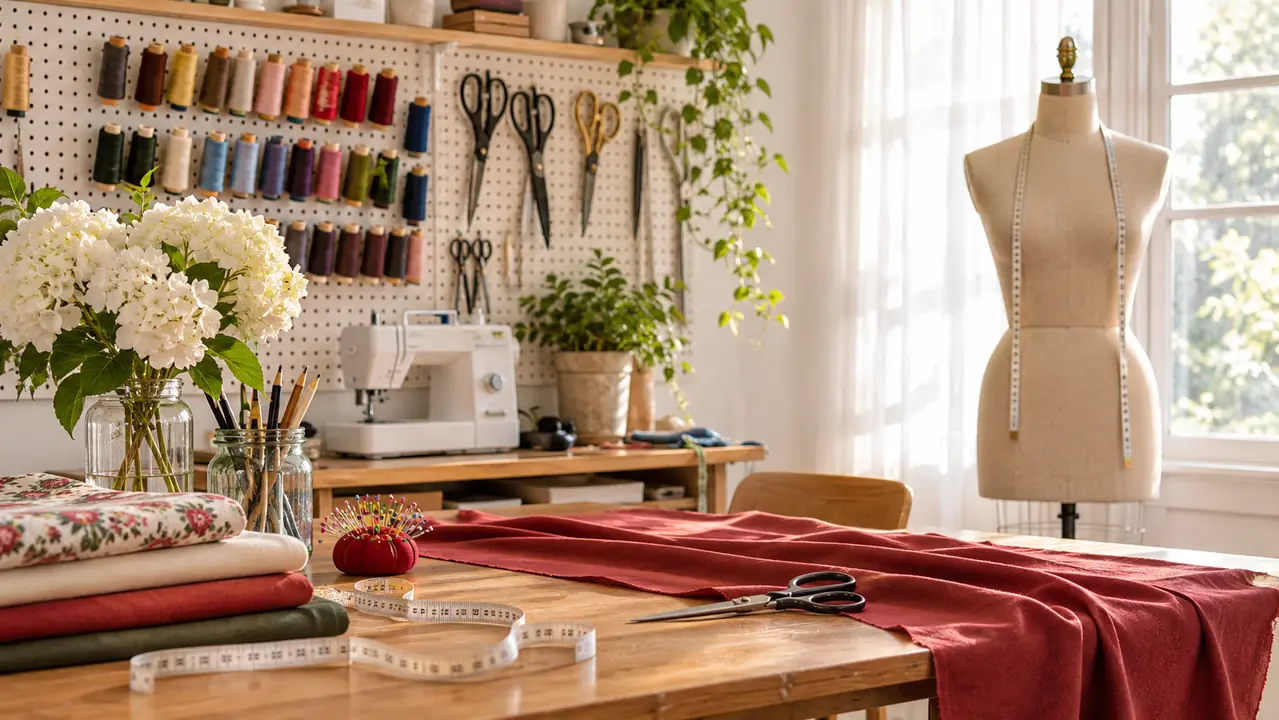
The first dress form in my sewing room was a polystyrene torso I stuffed with quilt batting and told myself was accurate. It was not accurate. I made my daughter a sheath dress on it, she got the thing over her hips, and then she stood in front of the mirror with her arms out like a scarecrow while I pinned and pretended not to see the problem. That was more than twenty years ago. I have been unreasonable about dress forms ever since, and I am not apologising for it.
The Dritz Sew You adjustable dress form, medium and large, has been standing in the corner of my sewing room for most of a year. My granddaughter, sixteen and growing in the wrong direction at speed, uses it more than I do. My daughter, who is a completely different shape, circles it when she visits and says something like, so that is what I am supposed to look like. She is not. A dress form is a measuring instrument with a neck, and the sooner you accept that the happier you will be with this one. Here is the honest version, including the parts that are a nuisance.
The Quick Verdict
Genuinely useful across US 12 to 18, with a height pole that ends the shoulder-to-floor guesswork. It is a hard shell, so you will pad it, and it will not flatter you. Set it with a tape measure, not with the numbers on the dials.
Amazon Check Today's Price →One form for three sets of measurements, and a height pole that tells the truth
Twelve multi-point body adjustments, nine smooth-rolling wheels at the sides and back, two front dials, a 360-degree hem and a center pole you set to your own shoulder-to-floor measurement. Check today's price and the size chart before you decide.
Amazon Check Today's Price on Amazon →How I've Used It
I sew for three people: myself, my daughter and my granddaughter. Three shapes, three sets of measurements, one form. That is the honest argument for an adjustable form over a fixed one, and it is the reason this Dritz earns its corner space instead of being a thing I shift from house to house and feel guilty about. In a year it has held a muslin for a wool coat I am still not finished with, a jersey dress that taught me more about negative ease than any book did, and four toiles for a homecoming dress my granddaughter changed her mind about twice.
Setting it up takes a few minutes and a tape measure, not a prayer. You take the chest, waist, hip and back length measurements you actually have, then turn the wheels and dials until the form matches. It is not a one-time job either. Every time the sixteen-year-old grows, I do it again. Every time my daughter comes over and asks me to fit a waistband, I do it again. That repetition is the real test of an adjustable form, and this one passes it without drama.
What it will not do is think. It holds whatever shape you give it, including a slightly wrong shape, and then it holds that shape very confidently while you cut into good fabric. That is not a flaw in the Dritz. It is a flaw in the idea that a form does the fitting for you.
The Dials and Wheels, in Plain Terms
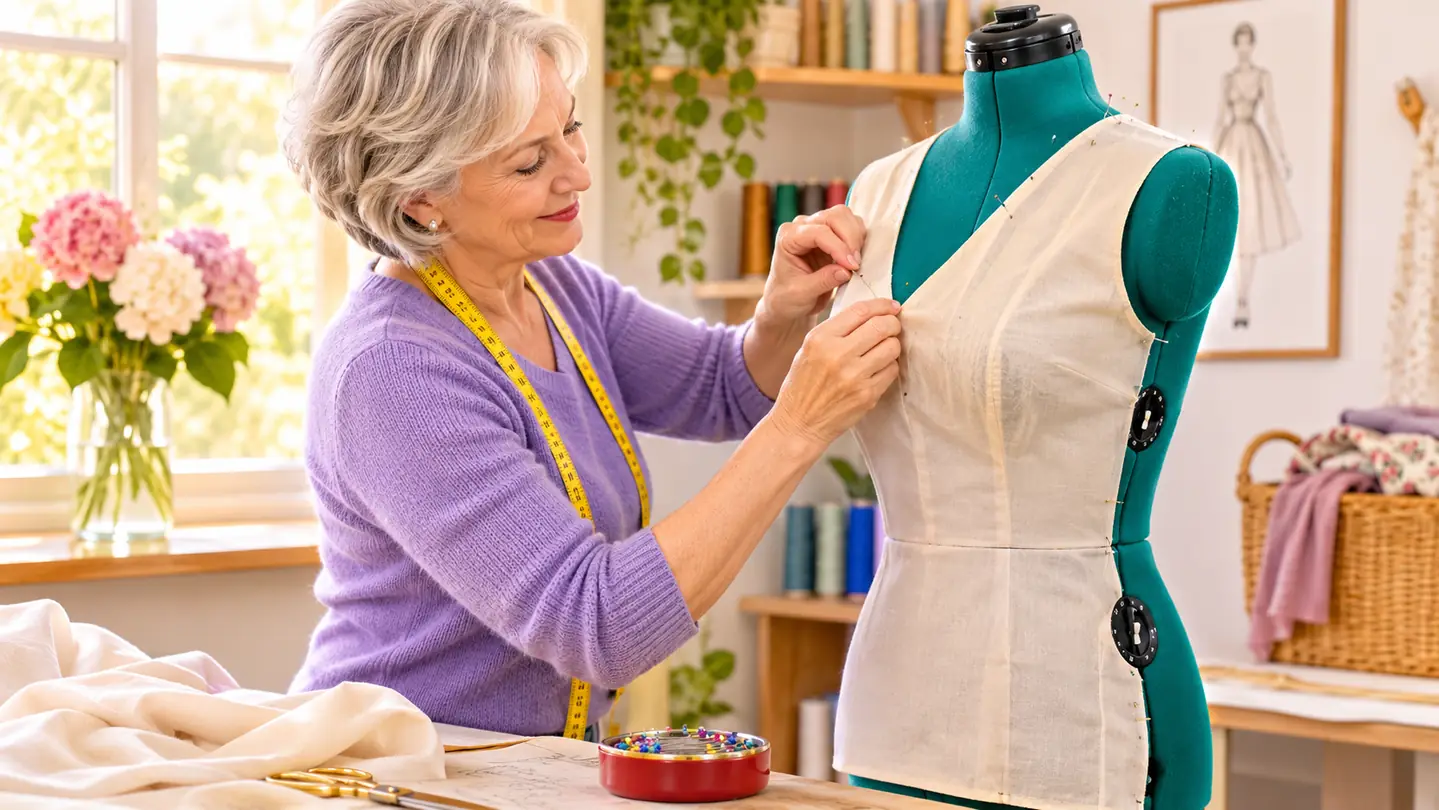
This form gives you twelve multi-point body adjustments: nine smooth-rolling wheels set into the sides and the back, and two auto-set dials at the front. Off to one side there is the height-adjustable center pole, which handles a separate job entirely. If you have only ever used a fixed form, the difference is like going from a wooden ruler to a tape measure. Same job, far more usable.
The wheels are the ones you will live with. They sit at the sides and back, which is where the shaping happens: bust, waist, hips and the vertical adjustments that decide where the waist actually falls. They roll smoothly, and that matters more than it sounds. A wheel that fights you means you overshoot, back off, overshoot again and eventually settle for close enough. Close enough is how you end up with a dress that fits the form beautifully and not the woman at all.
The two front dials are the convenience feature, and I use them for the quick changes. A waist that needs half an inch. A bust that needs a little more room before I pin a bodice. Because they are at the front, you reach them without walking around the form, and that sounds lazy until you have done a fitting where you circled the thing forty times.
Here is the complaint nobody puts in a review. The numbers on the dials are a guide, not a certificate. After a season of adjusting, mine no longer line up exactly with the tape, and I trust the tape. Measure the form with a tape after you set it, every single time. Your hands and the dials will disagree eventually, and your hands are right.
One more thing about the first setup. Do it alone, with the door shut, and give it twenty minutes. Waist first, then the bust, then the hips, then the back length, then the height. If you do the height first you will spend the rest of the session correcting it. I learned that the impatient way, on a Saturday, with a granddaughter waiting in the hall.
The Padding Question Nobody Warns You About
Every adjustable form is a hard shell under a fabric cover, and this one is no exception. What that means, and what the product photos never explain, is that the form is the skeleton, not the flesh. If you are sewing for a body with a soft belly, a fuller upper arm, a low seat, or a bust that sits differently from the form's, you will need to pad it. Batting, a soft bra, a bra cup, a rolled towel pinned at the seat. This is normal work. Nobody at any pattern company mentions it, and every experienced dressmaker does it.
I keep a bag of quilt batting and an old soft bra in the drawer under my cutting table for exactly this. My granddaughter is slim and straight through the middle, so the form suits her almost out of the box. My daughter carries her weight lower and softer, so on the days I sew for her I pad the seat and the belly and I write the padding notes in pencil on the pattern envelope. Then I have them for next time, which is the whole point of writing anything down.
That is the job, and it is also where the size range starts to bite. This is the medium and large, sized for US 12 to 18, with a 46 inch chest and a 40 inch waist as the outer limits. Those are real limits, not a marketing hedge. Padding adds. It does not subtract. Measure yourself honestly before you order, and if your waist is at or past 40 inches, buy a form in your size rather than telling yourself padding will sort it out.
After a season of adjusting, the dial numbers no longer matched my tape measure. Trust the tape. Your hands and the dials will disagree eventually, and your hands are right.
Height, Hem and Shoulder-to-Floor
The height-adjustable center pole is the feature I did not know I needed until I had it. You measure from your shoulder to the floor, you set the form to match, and suddenly the waistline, the hem and the crotch depth land where they land on a real person. That one measurement removes a whole category of problems that used to show up only when the wearer put the garment on and the hem sat three inches wrong.
The 360-degree hem adjustment is the other quiet win. You can set a hem line and work all the way around the form without picking it up and turning it, which matters far more on a long skirt than it sounds. I have marked a great many hems crouched on the floor with a ruler and a piece of chalk, and I do not miss it one bit.
The form weighs 10.1 pounds and is built from metal with plastic parts. Light enough that I can carry it from the window to the middle of the room on my own when the light is better there, and steady enough that it has not gone over on me. I still would not lean on it while cutting. It is a form, not a workbench.
Where It Falls Short
Four things, honestly.
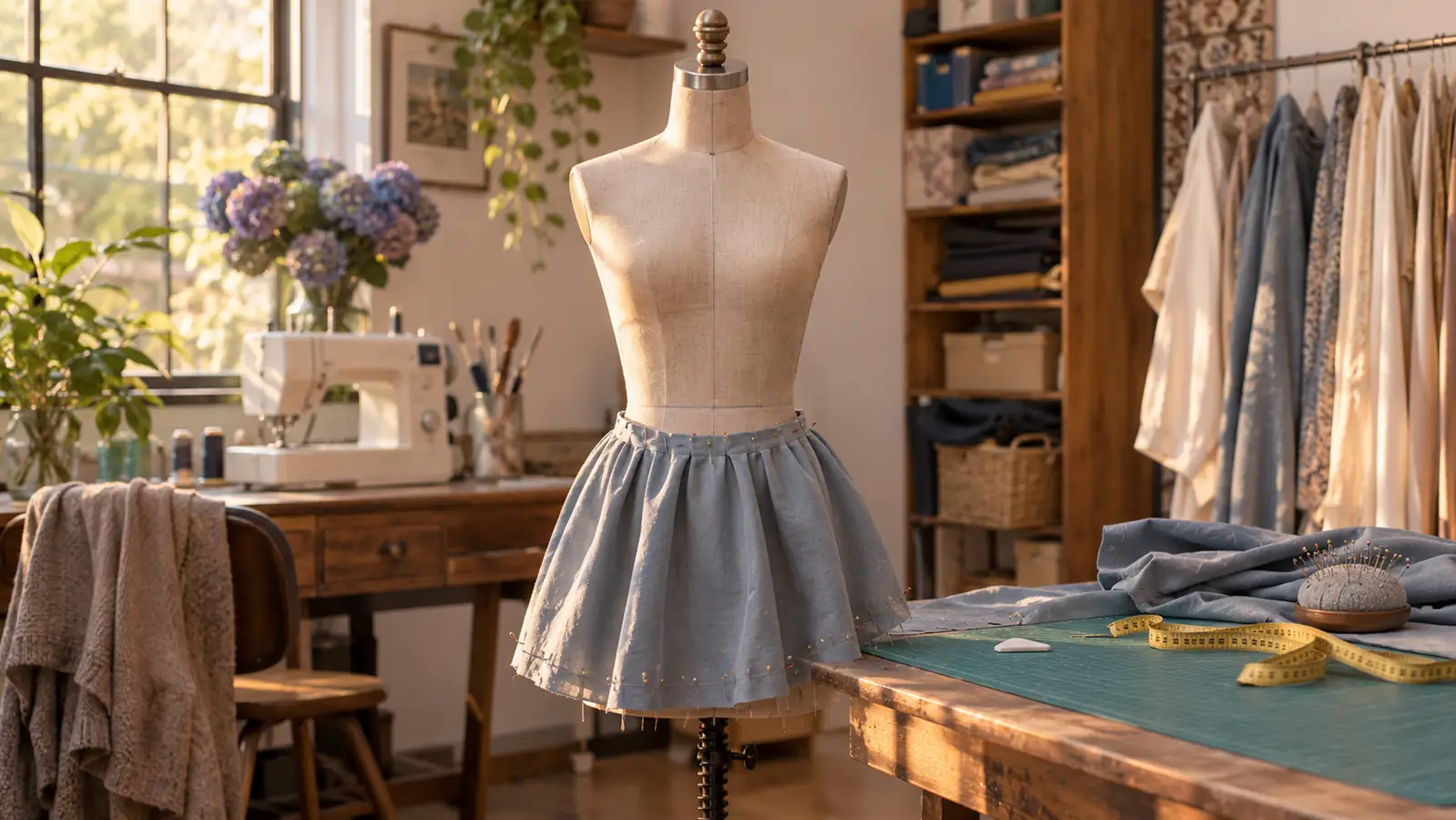
It does not stand in for posture. A real body slouches, shifts, drops one hip and holds one shoulder lower. The form stands perfectly, always, and that is a small lie built into every fitting you do on it. You compensate by fitting on the person whenever you can, and using the form for the parts that need two hands and a flat surface.
The cover is a fabric surface over a shell, and pins go in and out of it for years. Mine is holding up, but it will not last forever. Once a cover goes slack around a seam line the form gets subtly wrong, and subtly wrong is worse than obviously wrong because you do not notice it. Pin gently at the shoulders and keep the pins in a dish instead of your mouth.
The size ceiling is real, and the padded version of the form is only as good as your padding. This is one form covering a range of sizes, which means at the very ends of the range the proportions are a compromise. At US 12 it is generous. At the top of the range it is working hard for its living and you will feel it in the shoulders.
And it takes up floor space all year. This is not a small object. Mine stands in the corner and I have arranged the room around it, which is fine because I sew most weeks. If you sew twice a year you will resent it, and resentment is a bad reason to keep buying fabric.
What People Get Wrong When They Buy This
The most common disappointment, from my own first month with it, is expecting the form to look like a body. It does not. It looks like a form. It has no arms, no head and no give through the middle. If you bought it hoping to drape a whole garment and see a finished woman standing in the corner, you will be disappointed on day one. If you bought it to hold a shape while you pin and measure, you will be pleased.
The second mistake is setting it once and never checking. Measurements move. A form set in January is not necessarily right in June, and a growing sixteen-year-old will change it faster than that. I check mine against the tape any time a garment comes out fitting oddly, and nine times out of ten the form has drifted, not the pattern.
The third is buying at the wrong end of the range. This covers US 12 to 18 and it is honest about that. If you sit at the top of it, the form is at its limit and you will spend your sewing life padding. Aim to land somewhere in the middle of the range if your measurements allow it, and buy a different form if they do not.
What I Liked
- Twelve multi-point body adjustments, nine of them smooth-rolling wheels at the sides and back
- Height-adjustable center pole lets you match your own shoulder-to-floor measurement
- 360-degree hem adjustment saves you crouching on the floor with a ruler
- Covers US 12 to 18, up to a 46 inch chest and a 40 inch waist
- Weighs 10.1 pounds, so one person can move it around the room
Where It Falls Short
- It is a hard shell, so you will need batting and a soft bra to mimic a softer body
- The dial markings drift, so measure the form with a tape after setting it
- The size range stops at a 40 inch waist and a 46 inch chest
- No posture and no asymmetry, so fitting on the person still matters
- It stands in the room year round. This is not a small object
Who This Is For
Sewers who make clothes for more than one body and do not have room for more than one form. If you sew for a growing teenager, a partner, a friend and yourself, the adjustable range earns its fiddling. It suits anyone inside the US 12 to 18 range who wants a real shoulder-to-floor height and a hem line they can trust. It also suits a beginner who has been cutting on the table and guessing at fit, because seeing the shape standing in front of you teaches faster than any book on the subject.
It suits someone willing to measure the form with a tape, pad it where the body is softer than the shell, and redo the whole thing when measurements change. That is the bargain. The Dritz gives you the mechanism. The accuracy is your half of the deal, and no form on the market will do that half for you.
Who Should Skip It
If your measurements sit above a 46 inch chest or a 40 inch waist, skip it and buy a form in your size. The adjustable range will not reach, and the workaround is fiction. If you sew almost exclusively for one person whose measurements do not change, a fixed form in that exact size will fit better straight out of the box and cost you less fiddling. And if you want a form that disappears between projects, this is not that. It stands in the room, and you will plan around it, the same way you plan around the cutting table.
Measure the form with a tape before you trust anything on the dials
Twelve adjustment points, nine wheels at the sides and back, a height pole for shoulder-to-floor and a 360-degree hem, covering US 12 to 18. Check today's price and confirm the size against the measurements you have now, not the ones you had two years ago.
Amazon Check Today's Price on Amazon →