Short answer first, because that is what I want when I am reading one of these. If you sew for more than one person, buy the adjustable form. If you sew for one body, and you have already fitted a muslin to that body, a fixed mannequin will do the job and look better on a stand. Everything past this paragraph is the long answer, and it comes with the parts I do not love about each.
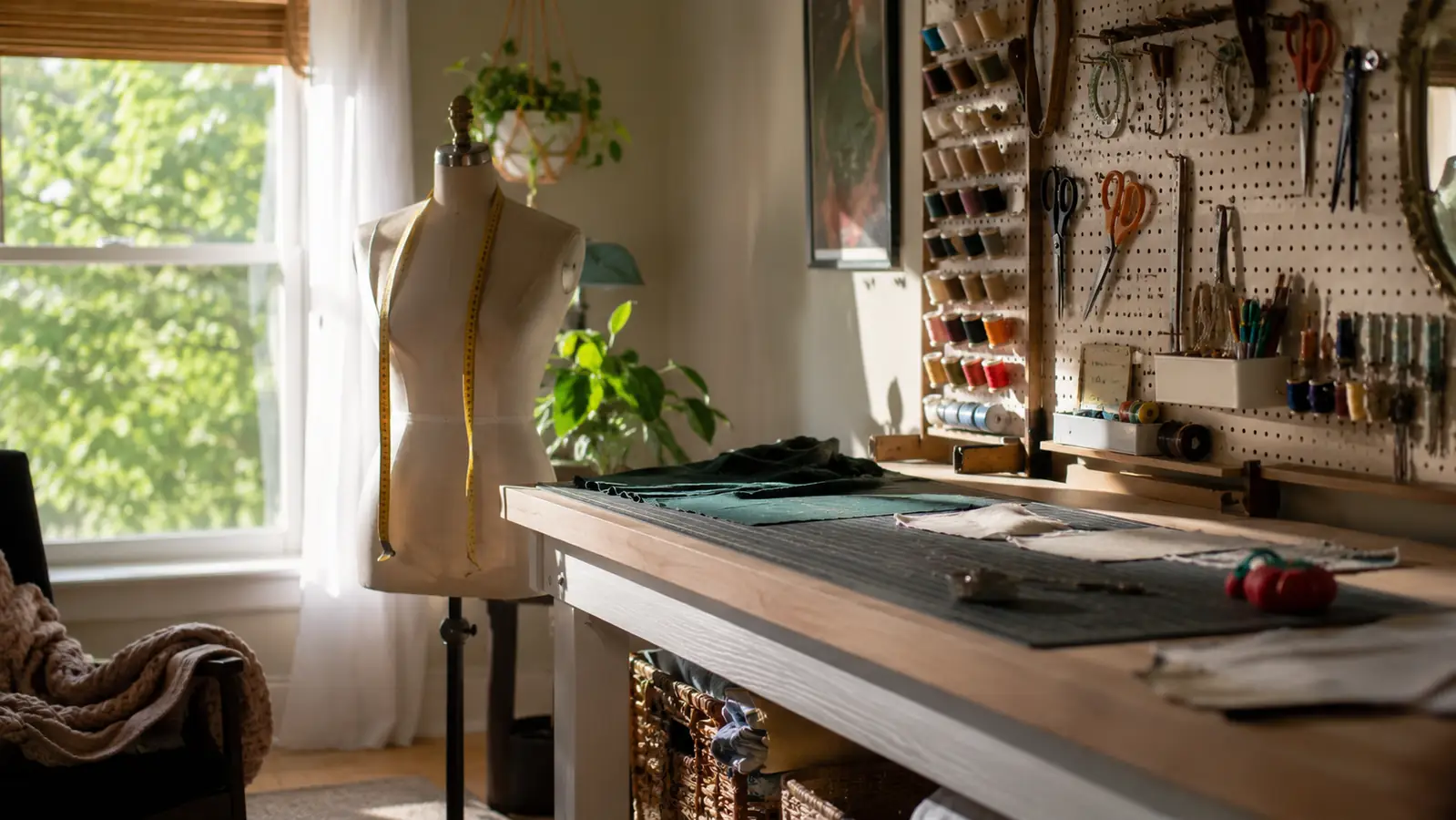
There are two dress forms in my sewing room. One is a Dritz Sew You, adjustable, standing by the window with a half-finished bodice pinned to it and a tape measure still hanging off the shoulder from yesterday. The other is a fixed mannequin I have owned for years, a solid thing with no moving parts and a linen cover I sewed for it myself. I use both. Which one I reach for depends entirely on who I am sewing for that week, and that is the honest heart of this comparison.
| Dritz Sew You | Fixed mannequin | |
|---|---|---|
| Adjustability | 12 multi-point body adjustments, 9 smooth-rolling wheels at the sides and back, 2 front auto-set dials | None. The measurements are whatever it was built as. |
| Sewing for more than one person | Resets between your numbers and your daughter's in about ten minutes | One set of numbers, permanently |
| Size range | US 12 to 18, with a 46 inch chest and a 40 inch waist | Whatever size it is. It does not become another size. |
| Height and hem | Centre pole matches your shoulder-to-floor measurement, plus a 360 degree adjustable hem | Fixed height. You hem to its floor, not yours. |
| Taking a pin | Pins go into the fabric panels; the adjustment seams and wheel housings do not take pins | A padded cover that takes a pin anywhere, all day |
| Stability while you press and pull | 10.1 pounds on a centre pole. Lean on it hard and it shifts. | Solid and heavy. It does not move when you work on it. |
| Looks | Dials and a pole are visible. Fine for fitting, odd in a photograph. | Shaped like a body with nothing mechanical showing |
| Setup before the first pin | Every measurement dialled in and checked twice | Unwrap it and start |
| Best for | Fitting garments across several different bodies | Draping, pinning, display and one-person fitting |
A fixed mannequin is one body, forever. The Dritz Sew You is the body you are sewing for this week, and next week it is somebody else.
Where Dritz Sew You Wins
Bodies change, and a household contains more than one of them. I sew for myself at 61, for my grown daughter, and for my granddaughter, who is 15 and still doing that thing teenagers do where last spring's measurements turn out to be a rumour. A fixed mannequin locks you to a single set of numbers. The Dritz form moves: 12 multi-point body adjustments, nine smooth-rolling wheels down the sides and back, and two auto-set dials at the front with clearly marked settings, so returning to a measurement you took in March is a matter of reading your own notes rather than hunting by feel.
The size range does a lot of quiet work here. This one is a medium and large covering US 12 to 18, with a 46 inch chest and a 40 inch waist. That takes my daughter and me comfortably and takes my granddaughter with room on the other side of the dials. A fixed mannequin covers exactly one of those three people. If you bought it secondhand the way I did, there is a fair chance it covers none of them, and you spend your sewing evenings pinning a garment onto a form that is a size and a half away from the person who will wear it.
Then there is height, which is the adjustment nobody thinks about until a hem is wrong. The centre pole brings the form up or down to match your shoulder-to-floor measurement, and that is the number that decides whether a hem hangs level on you or on a torso that happens to sit at a different altitude. Add the 360 degree adjustable hem feature and marking a level hem stops being a two-person job involving a yardstick, a mirror and a certain amount of bad language.
Resetting is not the ordeal people expect. Last month I fitted a dress for my daughter on a Tuesday, and by Thursday the same form was set for my granddaughter, who had grown an inch and a half since spring. That is four dials and about ten minutes of reading from a sheet kept in the cupboard. A fixed mannequin would have meant sewing the second dress on a body nowhere near hers, and then talking myself into believing the muslin looked fine.
Where a Fixed Mannequin Wins
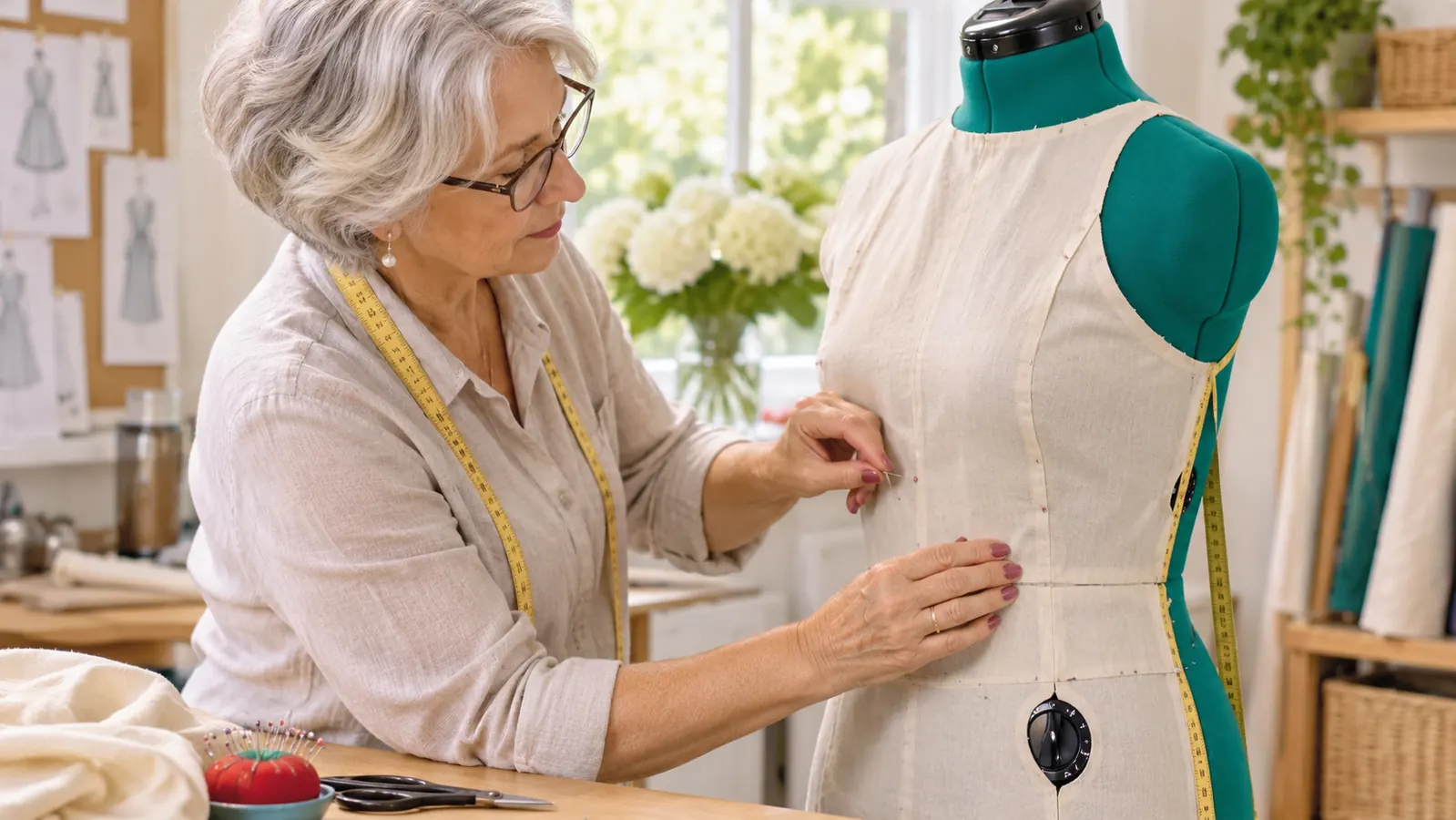
I am not going to pretend the adjustable form is better at everything, because it is not. My fixed mannequin is one solid piece. When I press hard on a waistband, or wrestle a heavy wool coat onto it, it does not move. The Dritz form weighs 10.1 pounds and it stands on a centre pole. If I lean on it the way I lean on the solid one, it will shift, and I will redo the pins I just set.
Pinning is the other place the fixed form earns its keep. Its padded cover takes a pin anywhere, all day, without complaint. The adjustable form takes pins in the fabric areas, but the seams between panels and the housings around those nine wheels are not pincushions. You learn where to pin. It takes an evening, and it takes a few pins that bounce onto the floor and get found later by your foot.
And a fixed mannequin looks like a person. No dials, no pole, no mechanical clutter. If you photograph finished garments, or if a client comes to the house, the solid form reads better in the room. The Dritz form reads like exactly what it is, which is a tool, and a fairly obviously mechanical one. That does not bother me in the slightest at the cutting table. It would bother me if I were building a look book.
The fixed form also comes out of the box ready. I remember unwrapping mine on a Saturday morning and having a bodice on it before lunch. The Dritz took an evening of measuring before it was useful, and the first garment I put on it was really a check on my own tape work rather than a fitting. That difference matters if you sew in short bursts and resent spending the first burst on setup.
If you sew for three bodies, stop fitting on a fourth
The Dritz Sew You adjusts at 12 points and is sized for US 12 to 18, with a 46 inch chest and a 40 inch waist. Write the numbers down once per person and the form becomes whoever is standing in front of you that week.
Amazon Check Today's Price on Amazon →What the Twelve Adjustments Actually Change
People read twelve adjustments and picture twelve knobs stuck to a torso, which is not how it works. Nine of them are wheels down the sides and back. Two are auto-set dials at the front. The remaining adjustment is the centre pole. You set the bust, the waist, the hips and the back length, then you set the height, then you check the height again, because a form that is right in the waist and wrong in the height produces a garment that fits while you stand still and climbs when you walk.
In the first week I checked every number three times because I did not trust dials I had never used. The bust came right on the first read. The waist was two inches off, and that was my error, not the form's: I had run the tape at the wrong point and only found out when a skirt hung crooked on the stand. The hips took a third pass. By the fourth evening I had a pencil sheet taped inside a cupboard door with three columns on it, one per person, and setup went from an evening to a couple of minutes.
The first setup takes longer than you expect. I had my daughter read the tape and call numbers while I turned wheels, and we still went back to the waist twice. That is not a fault in the form, it is the job. Write the numbers down for each person. Once you have a sheet for yourself, a sheet for your daughter and a sheet for your granddaughter, setup goes from half an hour of fiddling to about ten minutes of reading and turning.
What you get for that effort is a form that matches real proportions rather than a stylised set. The Dritz is full length, built on a metal and plastic frame, and the pole lets you bring the shoulder down to where your shoulder actually is. When I fit a bodice on it, the armscye sits where it will sit on the person wearing it. That is the entire argument for the tool, and it is a good argument. It is the reason I reset the thing instead of groaning about it.
The Pinning Question Nobody Mentions
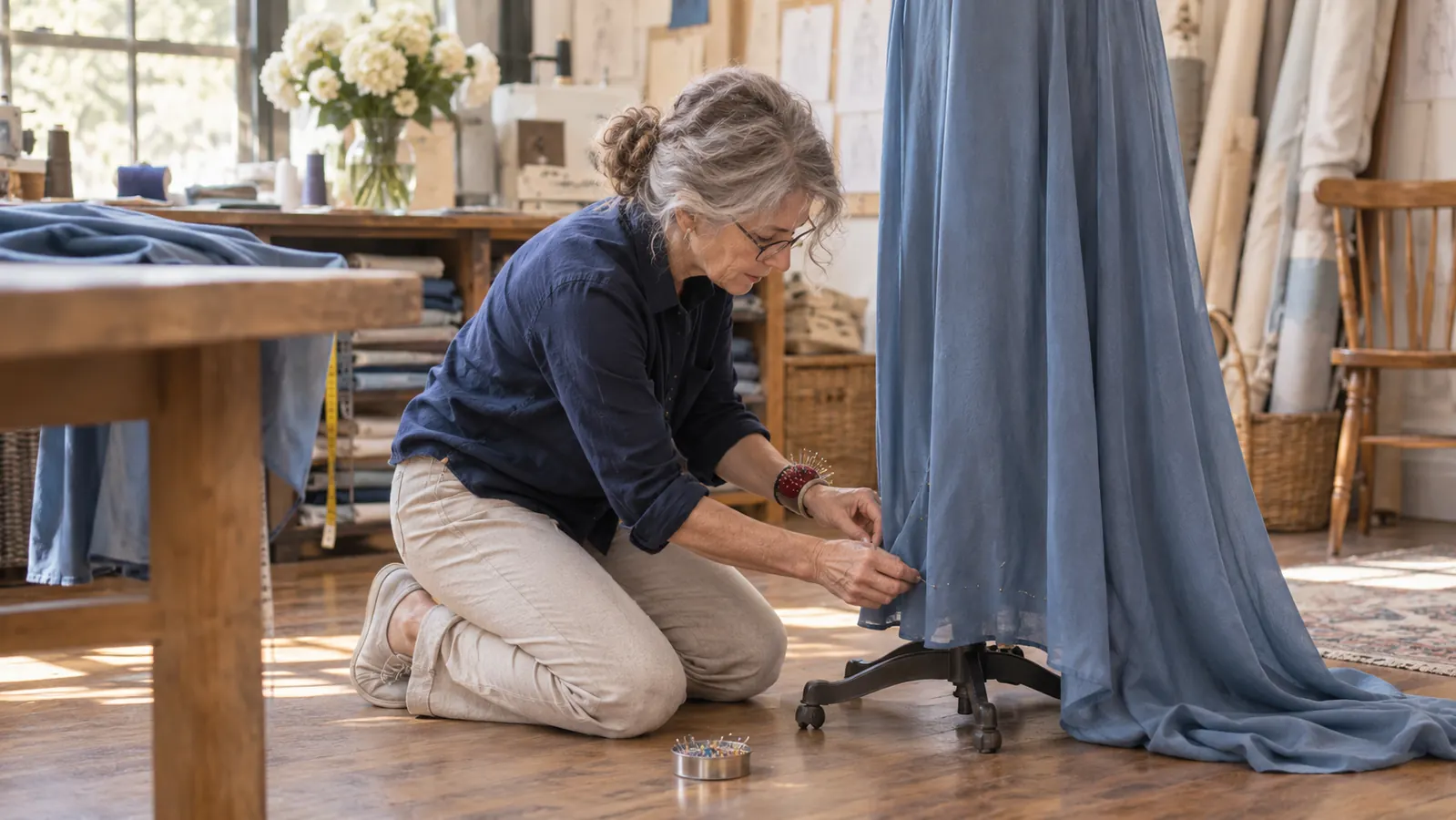
Nobody warns you about this before you buy, so I will. Adjustable forms and pins do not get along perfectly. The fabric panels take a pin. The seams between panels and the wheel housings do not. On a closely fitted bodice with a lot of shaping, you will want to pin into the fabric areas and use clips or a line of basting at the seam lines where the pins will not hold.
The evening it bit me was a wool coat. I had the back seam pinned at the waist, pressed down to smooth the fabric, and half the pins let go at once because I had pushed them through a housing instead of a panel. I picked them off the floor, moved the line a half inch toward the centre, and finished the seam in basting thread instead. That is the workaround and it is a good one: bast the shaped seams, pin the flat areas. It costs ten minutes and saves a coat.
My fixed mannequin has none of that geography. Everything on it is pinnable, which is why it still lives in the corner. If your sewing is mostly draping and pinning, that difference will annoy you more than adjustability will please you, and you deserve to know it before you order. If your sewing is mostly flat pattern work checked against a form for proportion, you will barely notice the seams at all.
What I Would Not Do With Either One
I would not treat either form as a substitute for a fitting on the actual person. A form has no posture. It has no belly that moves when you sit down, no shoulder that drops on one side because of the way you carry a bag. What a form does is get you close enough that the real fitting takes fifteen minutes instead of an afternoon of pinning, unpinning and apologising.
I learned that the ordinary way. I fitted a muslin for my granddaughter on the form, took in the waist until it looked right on the stand, and she put it on and could not raise her arms above her shoulders. The form had been perfect. It had also been standing straight with its shoulders level, which is not how a fifteen year old stands for more than eleven seconds at a time. I let the armscye out and learned the lesson for the cost of one evening and one muslin.
I would also not buy an adjustable form and leave it set to one body forever. That is a fixed mannequin with extra steps and a pole that catches your shin every time you walk past. The value is in the resetting. If you are never going to reset it, be honest with yourself about that and buy the simpler thing that does not need checking.
Who Should Buy Which
Buy the Dritz Sew You if you sew for more than one person, if your own measurements move, if you are between two pattern sizes and tired of grading up and down by instinct, or if you want to mark a hem against your own shoulder-to-floor height instead of guessing in front of a mirror with a yardstick and a hopeful expression.
There is one more case worth naming. If your bust and your waist put you in two different pattern sizes, which is most of the women I sew with, the form lets you see the whole shape at once instead of trusting a grading rule you found somewhere online. I spent years splitting the difference and hoping. Seeing it is faster, and it is easier to argue with a seam you can look at.
Buy a fixed mannequin if you sew for one body only, if you drape and pin far more than you draft, if you photograph finished garments, or if you want something that is ready the moment it comes out of the box and never needs a second look. There is nothing wrong with that answer. It is simply a different sewer's answer to a different set of evenings at the cutting table.
The form does not fit the garment. It gets you close enough that the real fitting, on the real person, takes fifteen minutes instead of an afternoon.
Set it once per person, then leave it alone
Nine wheels at the sides and back, two front auto-set dials, and a height-adjustable centre pole. Write the numbers down for each person you sew for and setup drops to about ten minutes.
Amazon Check Today's Price on Amazon →