
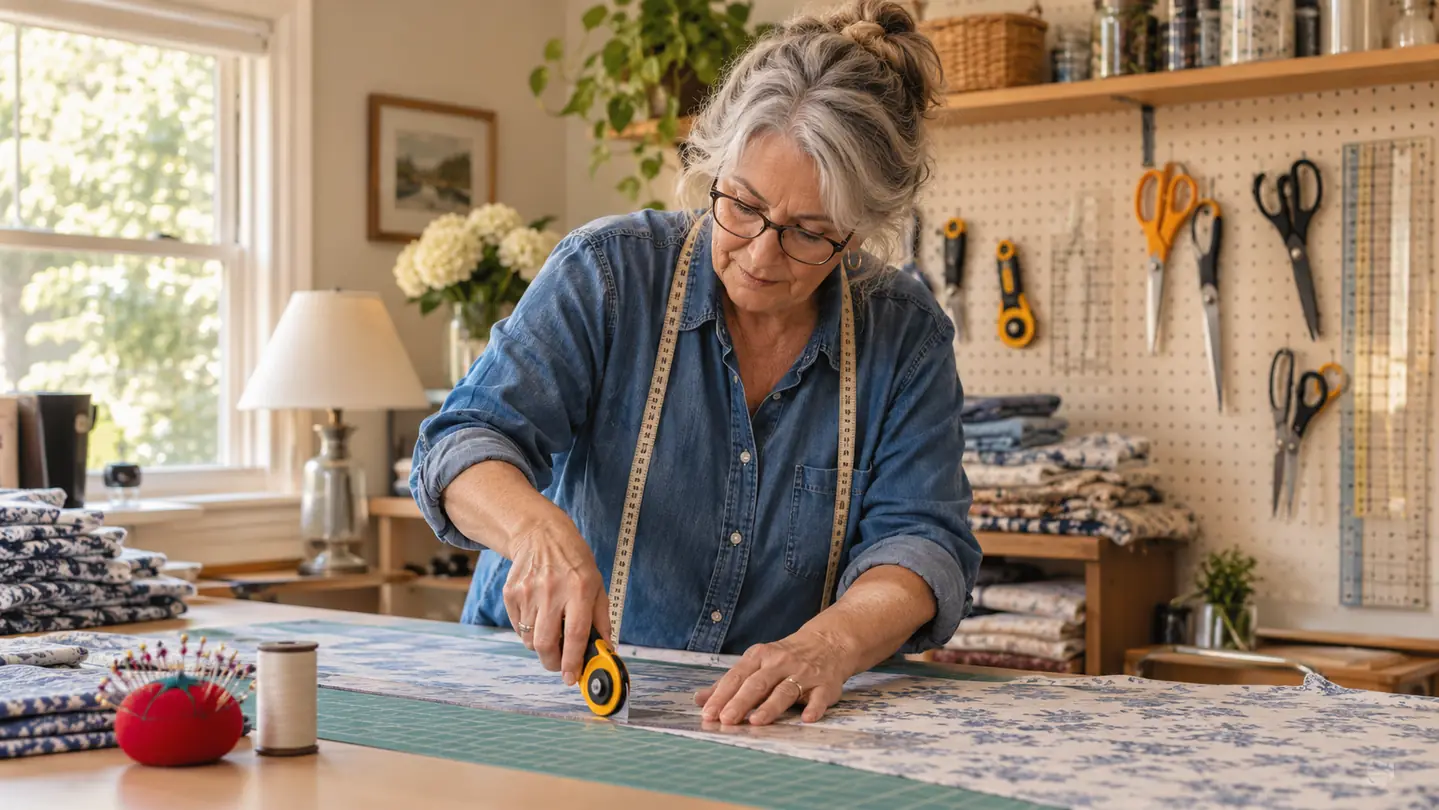
The thing nobody tells you about a rotary cutter set is that the cutter is not the part that decides whether you like it. The blades decide. The mat decides. The cutter is just the handle you push along the edge of something else. I came to the Honey's Heaven rotary cutter set after more than twenty years of cutting with shears on whatever flat surface was free, and my only real regret is that I did not set up a proper cutting station sooner. This kit was the first thing I put on mine.
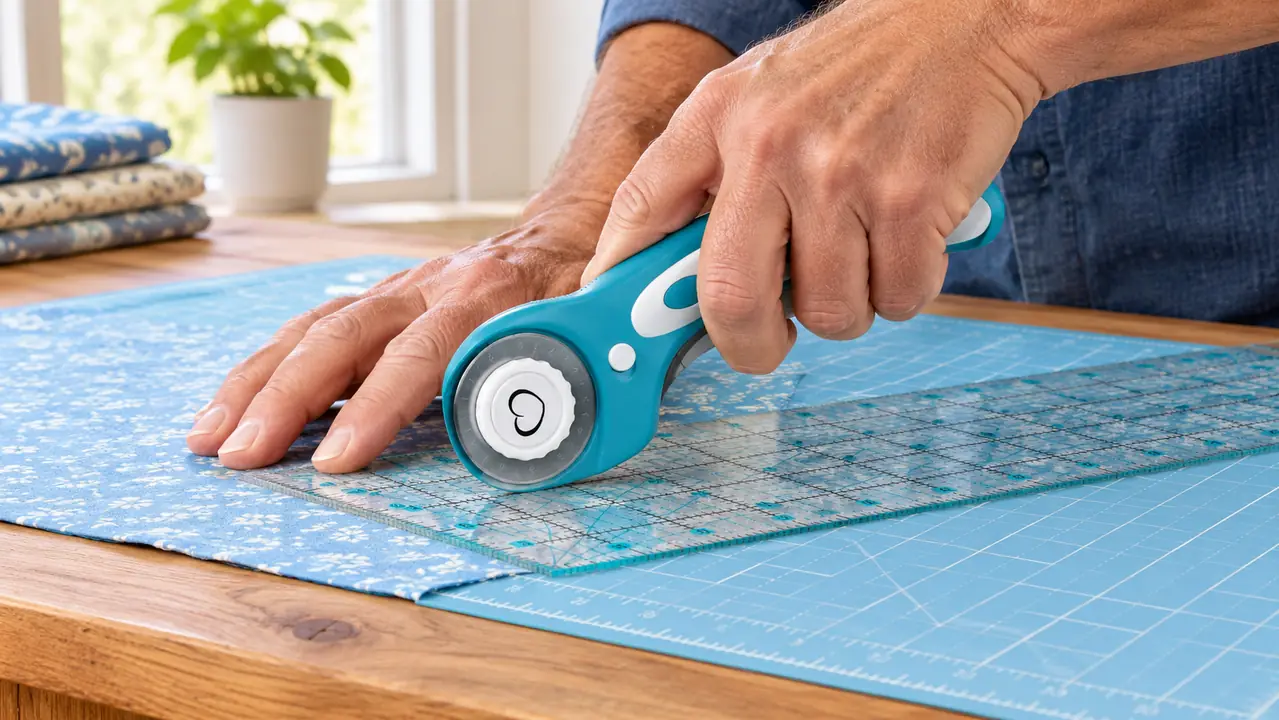
Inside the box of the Honey's Heaven set you get a 45mm rotary cutter, five extra 45mm blades, an A3 cutting mat measuring 18 by 12 inches with a printed grid of 16 by 10 inches at a thickness of 3 mm, an acrylic ruler, and a set of craft clips. That is a complete starting set. You do not have to go and buy a mat separately, which is the trap most beginners fall into, because a rotary cutter used on a bare table will ruin the table and the blade in the same afternoon.
The Quick Verdict
A sound first cutting station: five spare blades, a self healing mat and an acrylic ruler in one box. The A3 mat is the limit, not the cutter.
Amazon Check Today's Price →Five spare blades in the box is the whole argument for this kit
A blunt blade is what turns a clean cut into a re-cut. This set ships with five replacements, so you change the blade when it starts to skip instead of pushing through another metre of fabric.
Amazon Check Today's Price on Amazon →What Nobody Tells You Before You Buy a Rotary Kit
The first thing is that blades are a consumable, the same way machine needles are a consumable. Everyone says this and nobody believes it until it happens to them. A 45mm blade is good for a certain amount of fabric and then it starts skipping. You will not notice the skipping on one layer of quilting cotton. You will notice it on two layers of a wool blend, when the blade climbs instead of cutting and you end up with a ragged edge you have to trim back with shears anyway. Five spare blades is the single most useful thing about this kit, and it is also the reason I would choose it over a set that ships with one.
The second thing is that the mat is the piece you outgrow first. An A3 mat is 18 by 12 inches. That is a sensible size for a bodice front, a collar, a pocket, a waistband, and any number of small pattern pieces. It is not a sensible size for a skirt panel cut on the fold, or a full length sleeve in a wide fabric, or anything to do with a circle skirt. You will cut those in stages, or you will fold, or you will get down on the floor with the shears the way you did before. Nobody mentions this because the listing photographs make the mat look generous. It is not generous. It is adequate.
The third thing is that the ruler decides whether the cut is straight. A rotary cutter has no guide of its own. You are not cutting along a printed line, you are cutting along the edge of a ruler held down by your left hand while your right hand pushes. If the ruler shifts a sixteenth of an inch, the cut is a sixteenth of an inch off, and on a seam allowance that is the difference between a sleeve that sets cleanly and one that fights you all the way to the ironing board. The acrylic ruler in this kit does the job. It is not the reason to buy the kit and it is not the reason to avoid it.
The fourth thing is that a rotary cutter is not a safer tool than shears, it is a differently dangerous one. Shears cut when you close them. A rotary blade is exposed the moment you push the guard back, and it will roll across a fingertip with no more resistance than it gave the fabric. I keep mine guarded between cuts and I put the guard back on before I move the mat, not after. That habit is worth more than any feature on the listing.
How I Have Actually Used It
I sew for three people: myself, my grown daughter, and my teenage granddaughter. Three different body shapes, three different sets of adjustments, which means I cut a great many small pieces and I re-cut them when the muslin does not behave. My sewing room is a converted spare bedroom with one long cutting table and a pegboard wall, and the mat lives on the table permanently rather than going back in a cupboard. I have used this set on cotton poplin, linen, a wool blend suiting, jersey, and one unfortunate evening with a sequinned fabric that I would not repeat.
Jersey is where a rotary cutter earns its keep. A blade rolls through a knit without the drag you get from shears, and the edge stays clean instead of stretching out of shape while you cut it. I cut neckbands and cuffs on the mat, working against the printed grid, and got pieces that matched each other, which is not a claim I could make about my shears work on the same fabric. On the wool blend the blade went through two layers in one firm pass, and I did not have to lift the fabric to check whether the bottom layer had shifted, because it had not.
The sequinned fabric is where I learned the limit. Sequins are plastic, and a steel blade does not cut plastic so much as skate over it. The blade skipped, the edge came out ragged, and I stopped and went back to shears for that project. Then I spent ten minutes picking sequins out of the mat surface. The mat survived it. The blade survived it, mostly. That is the honest version of a good review: it is a capable tool with a specific kind of fabric it does not like, and you find that out the same way I did, at the table, mid-project.
The Blades Are the Whole Argument
Honey's Heaven uses SKS-7 steel in these blades, according to the listing. I cannot tell you what that means metallurgically and I would not trust anyone who claimed they could from a product page. What I can tell you is how the blades behave in use. They arrive sharp enough to cut a straight line through cotton with almost no downward pressure, and they hold that edge through a decent amount of work before you notice any change at all.
The change, when it comes, is quiet. You push a little harder. You go over the same line twice. You tell yourself the fabric is thicker than you remembered. Then you cut a pattern piece and the corner is ragged instead of crisp, and you finally change the blade. Changing it is straightforward: the handle has an adjustable screw system, so you loosen it, lift the old blade out, seat the new one, and tighten it back down. That same screw is what holds the blade stable while you cut, which means it is worth checking before every session, not once a month. I have had a blade shift mid-cut exactly one time, and it was because I had not tightened the screw properly after a change.
This is why the five spare blades matter more than the product photographs suggest. If you cut often, you will use them. It is not a defect, it is how rotary cutters work. Buying a set where the spares are already in the box means you are not stopping a project halfway through to order more, and you are not tempted to push a dull blade through another metre of fabric because you cannot face the interruption. That temptation is what produces the ragged edges and the re-cuts and the hour you lose at the table on a Tuesday evening.
The Mat, and the Size Question
The mat is 3 mm thick, self healing, and printed with a measuring grid. I have cut on mine for a long stretch of garment sewing and it is scarred. It is not a mystery why. Every cut that goes a hair past the ruler leaves a line. Self healing means the surface closes back up over time, not that the mat looks new forever. Mine has a visible track where I habitually cut seam allowances, and it still functions, and I expect it to keep functioning.
The grid is the detail to study before you buy. A printed grid of 16 by 10 inches inside an 18 by 12 mat means the outer inch on each side carries no measurements. That is normal, and it is still worth knowing, because your usable measuring area is the printed grid and not the physical edge of the mat. When I cut a strip for a waistband I measure against the printed lines, and if the piece runs longer than the printed area I move the fabric and start again from a line rather than eyeballing the remainder. Eyeballing the remainder is how a waistband ends up half an inch short and the buttonhole placement has to be redone.
If you sew garments rather than quilts, and you make full skirts or long sleeves or anything cut on the fold, you will want a bigger mat eventually. That does not make this one a mistake. It makes it a first mat. A large mat needs a table that can hold it, and my table takes an A3 comfortably and a larger one awkwardly. A mat that fits your table gets used every day. A mat that does not fit gets leaned against the wall behind the door, and then you are back to the dining table with the shears.
The mat is 18 by 12 inches with a printed grid of 16 by 10. That is right for a bodice and wrong for a skirt panel cut on the fold.
The Ruler, the Clips, and the Small Annoyances
The acrylic ruler is transparent, so you can see the fabric underneath while you line up the edge, and that matters more than you expect until you have used an opaque one on a patterned print. It is marked. It is not long enough to span a wide fabric in a single pass, so on long straight cuts I butt it against the mat printed grid and work in sections. Butting against the grid rather than against your own previous cut is the trick, because small errors compound when you chase the edge you just made.
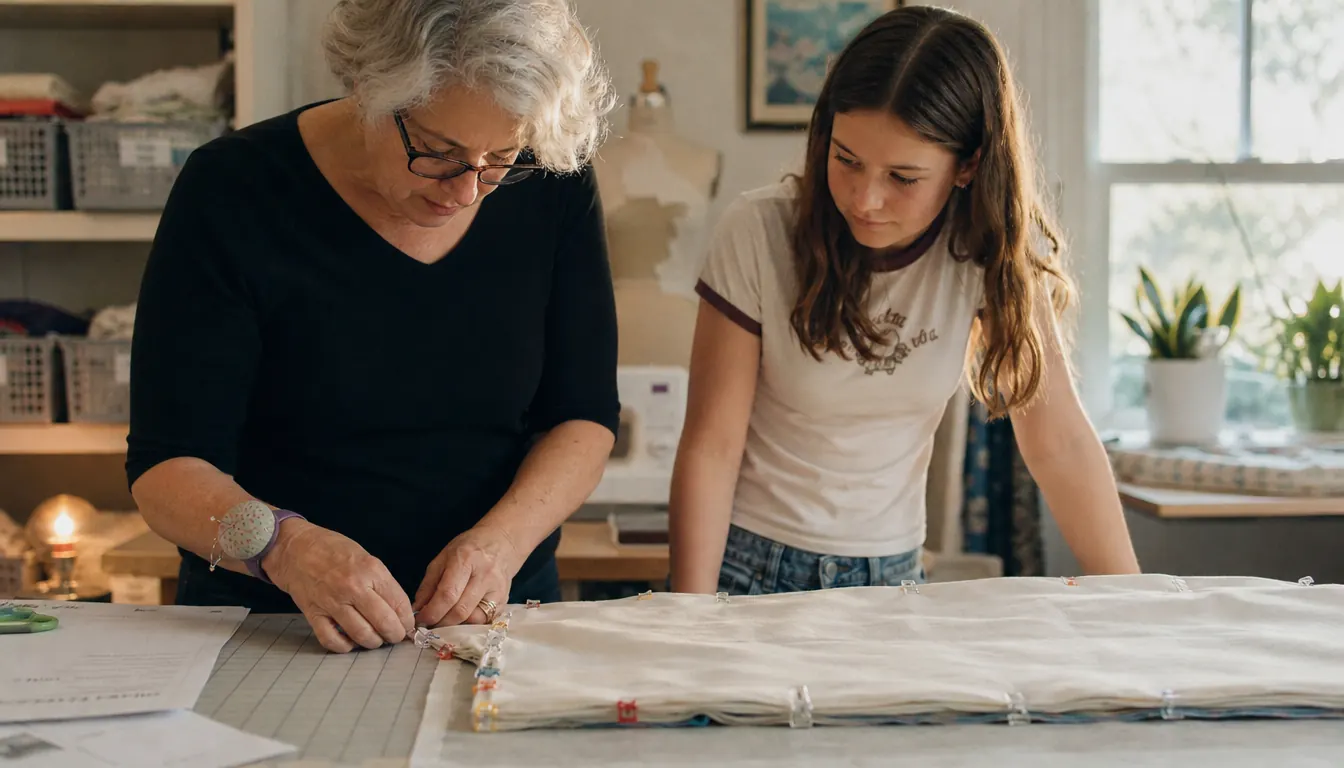
The craft clips are the piece I expected to ignore and did not. I use them to hold folded layers together before a cut, and to hold a seam while I move from the machine to the iron. They are not pins and they do not replace pins on anything delicate, but on a wool blend they are better, because they do not leave holes in the cloth. On a fine silk, use pins and use them sparingly.
The annoyances are small and worth listing. The whole kit is 1.02 kg, light enough to move around and heavy enough that you should not pick it up by the cutter, so lift it by the mat. The blade guard needs to be pushed fully home or it will slide, which I learned the hard way and which cost me one good blade. And there is no storage case, so the pieces live wherever you put them. I have a pegboard wall so mine hang within reach. If you cut at the kitchen table and pack everything away afterwards, keep the original box and use it.
The Setup That Makes It Work
A rotary cutter rewards a flat surface and punishes everything else. My cutting table is a board on two trestles, and the mat sits on it without rocking. If your mat rocks, if there is a gap under one corner, the blade will find that gap and the cut will wander. Check flatness before you start, not after you have ruined a piece of good linen.
Height matters as much as flatness. If the table is too low you lean into the cut and your shoulder carries the load, and after an hour of cutting you will feel it across your back. Mine comes to just below my waist, which lets me press down with my forearm instead of my shoulder. That is a personal measurement and not a standard, but it is the measurement worth taking before you build a station around any mat.
The last piece of the setup is blade discipline. I keep the spares in a small tin with a mark on the lid, and I change the blade the first time I catch myself pushing rather than rolling. Not the second time. The first. The difference between a sharp blade and a nearly sharp one is not the cut you make today, it is the four re-cuts you make next week because a corner came out ragged and you told yourself it would press out.
What I Liked
- Five extra 45mm blades in the box, so a dull blade is a two minute job and not an order
- Self healing A3 mat included, printed with a 16 by 10 inch grid for measuring strips
- Acrylic ruler lets you see the fabric while you line up the cut
- Adjustable screw system keeps the blade seated and stable in the handle
- Craft clips hold folded layers without leaving pin holes in wool and suitings
- Light at 1.02 kg, easy to move between rooms
Where It Falls Short
- An 18 by 12 inch mat is small for skirt panels and anything cut on the fold
- The mat scars with use, and the scars stay visible even after the surface closes
- No storage case, so the pieces need a home of your own
- The blade guard has to be seated deliberately or it slides
- Beaded and sequinned fabrics defeat the blade and send you back to shears
Who This Is For
This set suits someone setting up a cutting station for the first time who wants the three things they actually need in one box. It suits a quilter working in blocks and strips, where an A3 mat covers the piece comfortably. It suits a dressmaker who cuts bodices, collars, cuffs and waistbands and keeps the shears for the large panels. It suits anyone who has been cutting on the floor and has had enough of it. If you fit any of those, the five spare blades in the Honey's Heaven set make the decision easy, because you will use them.
Who Should Skip It
Skip it if you mainly make long dresses, full skirts, or anything with a panel wider than 12 inches cut on the fold, because you will spend more time repositioning the fabric than cutting it and you will be irritable within a week. Skip it if you work mostly in heavily beaded or sequinned cloth, because the blade will skate and you will go back to shears anyway. And skip it if you already own a cutter you like and a mat the size of your table. In that case the only thing you would be buying is spare blades and a second mat you do not need.
If your mat fits your table, you will actually use it
An 18 by 12 inch self healing mat, an acrylic ruler, a 45mm cutter and five spare blades. Check the current price and see whether the size suits the table you cut on.
Amazon Check Today's Price on Amazon →